
Trade Show Booth Checklist (Quick Read)
AI-generated highlights from the article — meant for fast scanning.
What it is
A complete, real-world checklist that guides exhibitors from choosing the right trade show to post-show ROI tracking. It covers strategy, budget, booth design, logistics, team training, and follow-up — not just setup.
Why it matters
Trade shows are expensive and unforgiving. Poor preparation leads to wasted budgets, missed leads, and lost deals — while proper planning is what separates high-performing booths from average ones.
Where it fits in the budget
This checklist helps you plan the full cost, not just booth space. It includes design, drayage, logistics, travel, tech, and hidden costs that often push total spend to 3–4× the booth price.
Key takeaway
Preparation is everything — from choosing the right show to following up within 48 hours. The companies that win at trade shows aren’t the ones with the biggest booths, but the ones with the clearest strategy, trained team, and disciplined execution.
Trade Show Booth Checklist: Exhibitor Prep in 2026
I’ve seen exhibitors lose $30,000 in booth space, and the contracts they were supposed to win from that booth, all because they forgot a power strip. Seriously. A $12 strip. This is the world of trade shows: rough, fast, and downright unforgiving of poor preparation. After more than 15 years of building booths, consulting with brands before their shows, and walking more trade show halls than I care to count, I can say with confidence: The difference between companies that really shine at a trade show and those that… “exist” on the trade show floor comes down almost entirely to preparation. This trade show booth checklist is not another one of those watery “10-point” articles. This is the real-world preparation framework I take clients through, step by step from choosing the right exhibit to measuring ROI a few weeks after the show. Each section of this guide is about a real thing; something that usually bogs you down. Use it, print it, discuss it. Just don’t go into a show without something like this.
Choosing Right Trade Show for Your Business
First and foremost in your trade show booth checklist before design, before budget, before hiring you need to answer one question:
Is this the right exhibit at all?
I’ve seen companies spend $40,000 to have a booth at a show where their actual buyers weren’t even there. A great booth. But zero pipeline. It’s a bitter lesson that could have been avoided with 30 minutes of research right from the start. To evaluate a trade show, look closely at:
- Attendee Profile Are your real decision makers there? Ask the organizer for demographics and audience type. They often do.
- Attendance figures from previous years Not just the total number. How many were “buyers” and how many were just other exhibitors walking around the hall?
- Competitor Presence If your main competitors attend every year, that’s a signal. If none of them attend, ask yourself why.
- Cost per Contact/Contact Divide the total cost of the trade show by a reasonable estimate of the number of leads and compare it to other lead generation channels.
- The credibility of the trade show in your industry Talk to past exhibitors, not the organizer. Talk to actual exhibitors from previous years.
- Location and Time Does the trade show overlap with other major events in your industry? Is the venue suitable and accessible to your target audience?
My honest opinion: New companies are better off starting with a good, local trade show and then moving on to the big national shows. The skills, logistics, and team preparation you gain at a small trade show are worth more than the “exposure” you get at a big show you’re not ready for. read mor about best trade show flooring
Trade Show Booth Checklist for Budget Planning
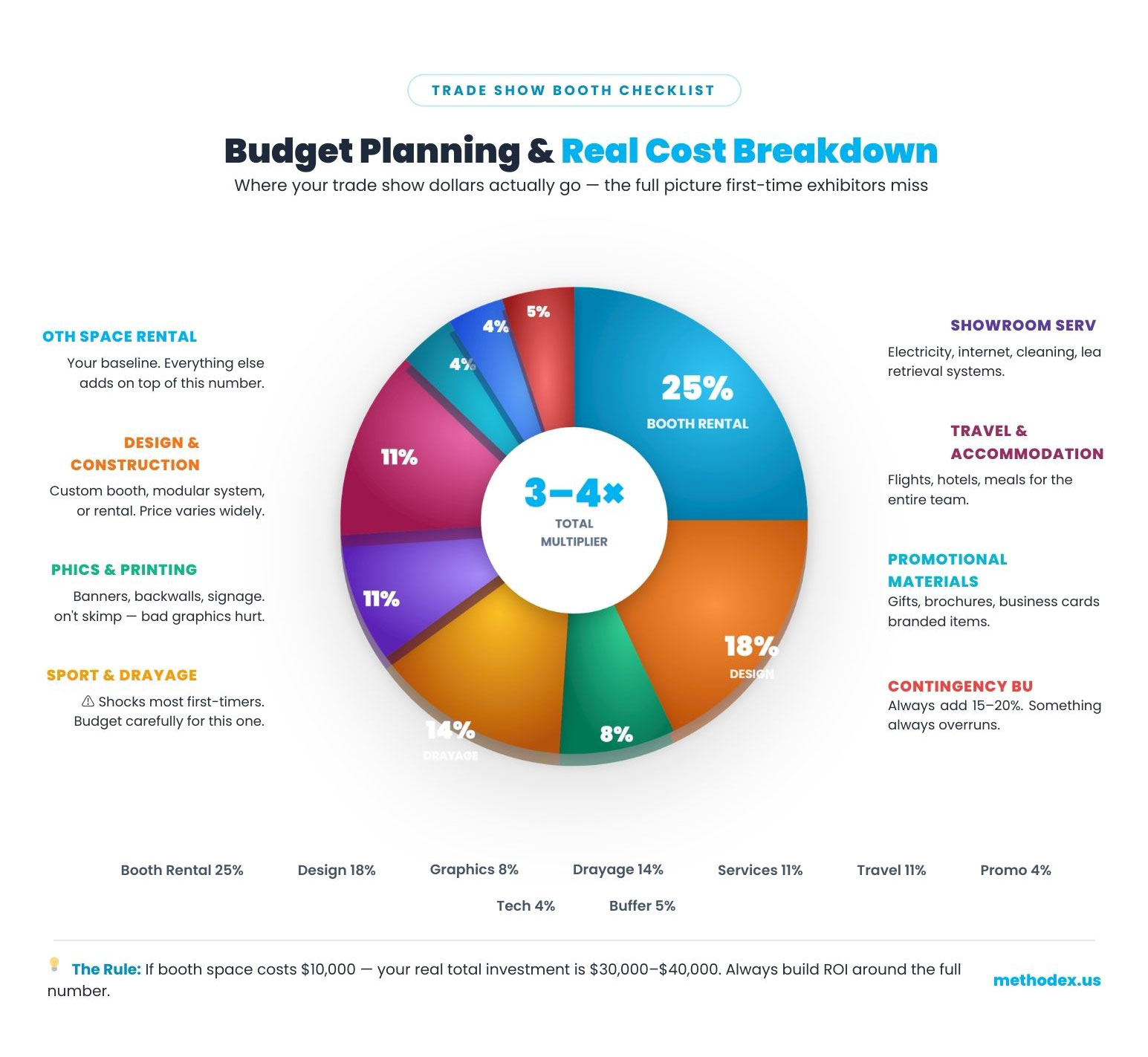
The number I hear most from first-time exhibitors is the cost of renting the booth space. That’s it. Just the space. And then they’re shocked when the final bill comes, and it’s 3 or 4 times that number. This is what a real trade show budget looks like, and your checklist should cover:
➽ Booth space rental your starting point. Everything else hinges on this number.
➽ Booth Design and Construction Custom booth, modular system, or rental. Depending on size and complexity, the price range can vary greatly.
➽ Graphics and Printing Banners, backwalls, signs, catalogs, etc. Don’t skimp here; bad graphics can ruin even a good booth.
➽ Transportation and Drayage Getting the booth to the show and handling/moving costs on site. Many people are shocked by these costs the first time they see them.
➽ Showroom Services Electricity, Internet, lead collection device/system, cleaning, carpet or flooring (if not included).
➽ Travel and Accommodation Flights, hotels, meals, and public transportation for the entire team.
➽ Promotional Materials Gifts, brochures, business cards, branding items.
➽ Technology Tablets, displays, demo equipment, lead capture apps.
➽ Contingency Budget Always allow for an extra 15-20%. Something always ends up being more expensive than you think.
A rule of thumb I’ve used with clients for years: If your booth space costs X, your total investment is likely to be 3-4 times that when you factor in everything. Base your ROI expectations on the whole number, not just the space rental. To read more What is Trade Show Booth Drayage?
Booth Design & Branding Checklist for Trade Shows
Design is where most exhibitors either invest wisely or lavishly waste their money. I’ve seen $80,000 booths that left everyone confused as they walked by, and $8,000 booths that generated more leads than any other booth. The difference isn’t “budget” the difference is “clarity.” Your booth design and branding checklist should cover the following:
-The 3 Second Rule:
Someone walking past your booth at a normal pace should be able to figure out exactly what you do in 3 seconds or less. Test it ruthlessly.
-one clear booth message :
One core message: Not five. Not three. One message What is the most important thing you want the visitor to take away?
-Brand Integrity :
Colors, fonts, and images should be consistent with your website, advertising, and sales materials. Inconsistency slowly eats away at trust, without your audience even realizing why.
-Height and Visibility:
Use vertical space. Headers that are at eye level get lost in crowded halls. Go as high as regulations allow.
-Traffic Flow :
The physical layout should be such that people naturally enter the booth rather than stand at the edge of it.
-Lighting :
This is often underestimated. Good lighting makes a booth look more expensive and professional. Bad lighting, the exact opposite.
-Demo or Experience Space :
If you can get the visitor to do something touch, try, demo the quality of engagement and leads will increase dramatically.
One thing I always tell clients: Design your booth for your customer, not your CEO. I’ve been in too many meetings where an executive wants the logo to be bigger or the product photo to be more prominent, when what really grabs the visitor is a clear “problem/pain” that speaks directly to them—design for the audience that is standing in front of your booth. read more about create Interactive Trade Show Booth
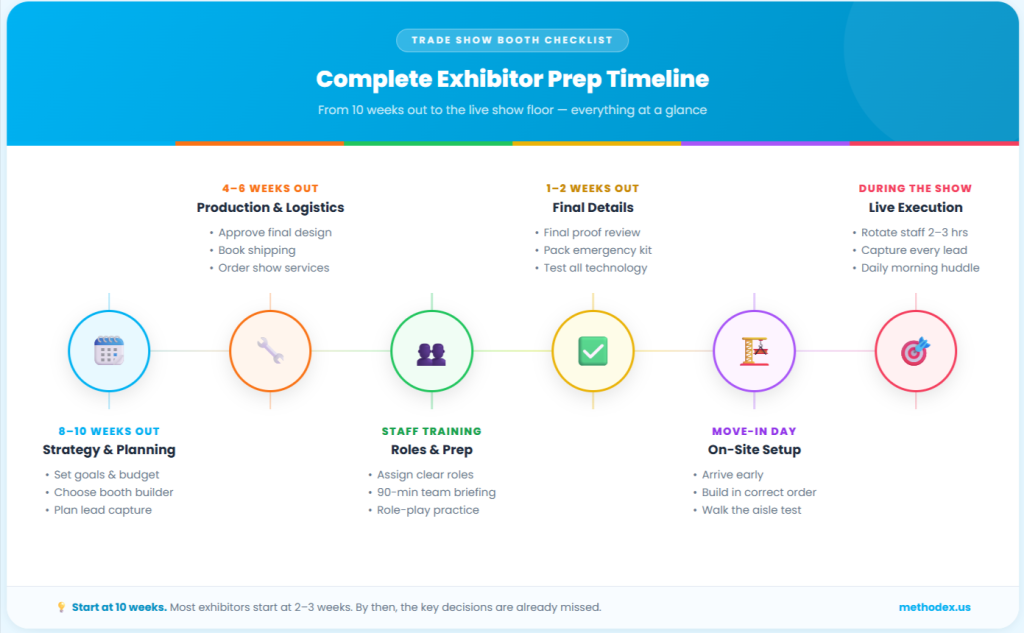
8–10 Weeks Out: Start Your Trade Show Booth Checklist
Most exhibitors don’t start thinking about their booth until two or three weeks before the show. By then, it’s too late. The things that will truly shape your success booth design, floor plan, messaging should be decided when you still have time to think and correct mistakes. With 8-10 weeks to go, here’s what you need to finalize:
- Confirm the exact dimensions of your booth space with the organizer don’t guess. I’ve seen companies design a 10x20 booth for a 10x10 space.
- Identify your primary purpose for being there leads? brand awareness? product introductions? These seem obvious, but they’re not; they affect all design and staffing decisions.
- Lock in the full budget with the same realistic framework as above.
- Choose a booth builder or finalize an in-house team. If you outsource, the window for quality work closes very quickly after 8 weeks.
- start the graphic brief. What message should someone walking by read in less than 3 seconds?
- Start a lead capture program what system are you using? Who is responsible? How does the data get into the CRM?
The goal-setting part is where most companies underestimate themselves. They say, "We want leads," but they haven't defined what a qualified lead is, how many leads they need to justify the cost, or what the post-show follow-up should be like. Clarify these now, not in the middle of the show floor. to read more Drive Traffic to 10×10 Booth
4–6 Weeks Out: Production & Logistics Checklist
This is when everything gets real and tangible: design approval, physical item production, shipping schedule it all starts together. If you’re not organized here, you’ll be forced to make hasty and expensive decisions under pressure.
➤ Confirm the final booth design and all graphics file format correct, bleed lines checked with the printer.
➤ Order booth parts, flooring, and furniture. Lead times vary widely; don’t assume two weeks is enough.
➤ Book shipping to and from the show. Know your Advance Warehouse and direct-to-show delivery deadlines. Missing these deadlines is costly.
➤ Finalize and test your lead collection method.
➤ Select booth personnel not just anyone who is “free,” but someone who is truly a good representative of the brand under pressure.
➤ Order show services: electricity, rigging, cleaning, and internet. These are usually much more expensive if ordered on-site.
➤ Register your staff and book travel and accommodation.
The logistics department is often the most surprising. Almost all major shows have a “pre-show warehouse” that will pick up cargo before the show opens. If you miss the delivery window, the in-hall Drayage costs will be mind-boggling. I’ve seen a small pallet cost $800 just because it arrived two days late.
1–2 Weeks Out: Final Booth Checklist Details
You’re so close now. Big decisions have been made. This is where the little things the things that seem “unimportant” can become real problems if not managed:
⚡Final Proof Spelling, phone numbers, addresses, links, QR codes. Have someone who isn’t a designer double-check everything.
⚡Pack an emergency kit: extra screws, zip ties, glue, scissors, basic tools, wire, power strip, markers, backup copies of plans, and contact information.
⚡Test all technology: tablet, demo screen, card/badge scanner, laptop—update software. Charge everything.
⚡Complete training and role-play session.
⚡Confirm all travel arrangements: flights, hotels, ground transportation, and arrival times for everyone.
⚡Double-check your cargo tracking know exactly where your shipment is.
⚡Carry a printed copy of everything: your show schedule, your show service orders, your booth map, your show management contact list.
An emergency kit may seem obvious, but I’ve seen exhibitors spend an hour the first morning looking for the right glue or wrench. That’s an hour they could have been talking to a customer. Pack your kit. You’ll use it.
Move-In Day: On-Site Booth Checklist
Move-In day is “controlled chaos.” Everyone is building, drilling, negotiating with union forces, and getting little sleep. The companies that manage this day well are the ones that have their work cut out for them before they arrive.
➤ Arrive early sooner than you think you need to. Power and equipment run out very quickly.
➤ Before you need to load, make sure all your supplies are there. If anything is missing, report it to the show management immediately.
➤ Build in order: first the floor, then the structure, then the graphics, then the furniture and accessories, and finally the technology.
➤ Test the electrical connections before you lean on them. See where the actual outlet is, not guess.
➤ Shine the light on key points not the ceiling, not the faces of visitors.
➤ Walk down the aisle at your normal pace past the booth. What is actually visible? Can the main message be conveyed in 3 seconds?
➤ Verify internet and test SIM card backup.
➤ Find the nearest restroom, emergency exit, and the show management office.
I’ve done this “aisle” test with hundreds of clients, and almost every time they want to change something. You've seen the booth from the front in the studio or on screen. But on the show floor, the angles, the lighting, the booths next to you, and the traffic are different—test before you open, not after. read more Top Agriculture & Farming Trade Shows in USA 2026
During the Show: Working the Booth Checklist
It’s starting now. All that preparation either works or it doesn’t but there are still things you can do (or not do) that will really make a difference over the three days of the show:
➽Rotate the crew every 2 to 3 hours. Show fatigue is real, and it takes its toll on your face, your body, and your energy. Fresh energy is better for engagement.
➽Record every lead even the “maybes.” Evaluate later. On the show floor, record everything.
➽Add a context note to the lead immediately after each conversation. “Interested in enterprise pricing, decided by Q3, follow up Thursday” is ten times more valuable than a blank name.
➽Walk around the hall once a day. See what the competition is doing, what’s drawing the crowd, what elements you wish you had.
➽Keep the booth clean and tidy. By six o’clock on the first day, the booths are a mess. A messy booth sends a message.
➽A quick morning meeting 10 minutes a day. What’s working? What’s not? What needs to change?
Visiting competitors is something that many people skip because they feel “too busy.” Take your time. 30 minutes a day, a full round. Each time you learn something, either a usable technique, or at least a confirmation that your booth is better than you thought it was.
After the Show :ROI & Follow-Up Checklist
This is the part that most exhibitors either skip, do sloppily, or do haphazardly, and the data is worthless. And it’s really the most important part of the whole thing because without it, you’re just guessing whether the show was worth it or not. Your post-show checklist should include:
- Follow up on all leads within 48 hours. Not a week later. 48 hours. After that, response rates drop significantly.
- Categorize leads early on: hot (ready to buy or close), warm (interested but time-consuming), cold (initial or uncertain).
- Track leads through the pipeline for at least 90 days. A week’s worth of results tells you almost nothing.
- Calculate the cost of the entire show every dollar, even the staff time.
- Count the number of leads, meetings, proposals, and deals closed/in progress.
- Calculate cost per lead and cost per opportunity, and compare to other channels.
- Hold a team debriefing session within the first week what worked? What didn’t? What are you eliminating? What are you enhancing?
- Document the collection and return process: Take photos of the booth, note any damage, and verify that the return labels are correct.
- Create a memo file now for next year. You won’t remember the details in six months.
I put a lot of emphasis on the “90 days” part. I’ve seen companies say “failed” two weeks after a show, but the second month, they closed three big deals from the same show. Show leads tend to have a longer sales cycle than inbound leads. Adjust your evaluation interval accordingly. And honestly: What if, after fair evaluation, the show really didn’t work? That’s it. Not every show is worth renewing for next year. The ROI measurement process gives you the clarity to make decisions with confidence, not guesswork.
Staff Training and Roles: The Trade Show Booth Checklist Most Teams Skip
Your booth can be beautiful, your booth space is great, your giveaways are great but if your crew isn’t ready, your results will still be poor. I believe that training the team has the highest ROI of the entire checklist and is almost always the least important part in practice. A real team preparation process looks like this:
-Be clear about roles before the show who will capture the lead? Who will do the demo? Who will manage booth logistics? Who is the “decision maker on the floor”?
-Hold a 90-minute meeting the week before. Include: Elevator pitch, key product points, 5 common objections and answers, lead quality questions, and a daily schedule.
-Define a qualified lead. Budget? Decision time? Decision authority? The team needs to know who to spend their time with.
-Practice a conversation starter. Not a sales pitch a conversation starter that gets the prospect involved, not a smile and a nod.
-Set standards of behavior no cell phone calls in front of visitors, no eating in the booth, no sitting unless necessary, and no internal chatter between crew members while the hall is open.
-Schedule shifts so that no one is on their feet for 8 hours straight. Fatigue shows and can ruin performance, even if you don’t realize it.
What I do with clients before every show: a quick role-play. I play the role of a skeptical visitor, and the crew has to manage. It’s uncomfortable, and that’s exactly how it should be. The first time someone gets flustered in a role-play, it’s much better than getting flustered in front of a real customer. read more about Vinyl Floor Vs Laminate in trade show booth
Technology and Digital Tools in Booth Checklist
The tech sector has changed a lot in the past decade, and frankly, some exhibitors still haven’t caught up. The right tools make teams more efficient, produce cleaner work, and enable faster follow-up. The wrong tools, or the lack of them ,create friction throughout the process. When it comes to technology, these should be on the checklist:
-Lead capture app Most trade shows have an official badge scanning app. Use it. Manually collecting business cards is inefficient and misses the point of the conversation.
- CRM connectivity Ideally, the lead capture tool will feed data directly into the CRM so that follow-up can begin without manual data entry.
- Demo technology Tablets, touchscreens, looped video, interactive demos… anything that makes your product/service tangible.
- Charging station Both for team devices and (if desired) for visitor engagement. When someone’s phone is charging, it stays in the booth longer.
- SIM card hotspot as a backup Trade show center Wi-Fi is notoriously spotty. If your demo or lead capture is dependent on the internet, have a backup.
- Social Media Content Scheduling Schedule your show week posts before you go. You don’t have time to think about content on the show floor.
- Show App Presence Most shows have an official app. Complete and optimize your booth profile, products, and session registration before the show starts.
I’m a little traditional on one thing: I still recommend a one-pager for those who want something physical to take with them. Digital is great for when the phone dies, the app crashes, or the visitor really prefers paper. Cover both.
Common Trade Show Booth Mistakes And How to Avoid Them
I’ve been on the trade show floor long enough to have a pretty long list of things that go wrong. Here are some mistakes I see over and over again at companies large and small, with little or no budget, new and experienced:
- Designing the booth for internal stakeholders instead of the target audience. Your marketing manager loves close-up photos of the product; your customer responds to the “problem statement.” Design for the customer.
- Bombarding the booth with messages. Three messages cancel each other out. One message sits. Cut it out mercilessly.
- Skipping the training session because “everyone knows the product.” Knowing the product is a different skill from effectively presenting it to a stranger in a crowded hall.
- Ordering on-site exhibition services. The difference in electricity or internet prices between pre-ordering and ordering on-site can be 40 to 60 percent. Order early.
- Ignoring pre-show warehouse deadlines and paying for expensive Drayage.
- Underestimating setup time. If the setup will take 4 hours, block out 8 hours.
- Leads are going cold due to poor follow-up. The follow-up window is short. Prepare your messaging/follow-up sequence before the show, not after you return.
- Measuring ROI incorrectly and making decisions based on “feel” instead of data.
- Taking too much stuff. I’ve seen booths that look like warehouses. Edit heavily. Less is almost always better.
The mistake that hurts the most is failure to follow up. The rest are largely recoverable late delivery, typos, even a bad setup day. But leads are going cold because no one followed up? That money is never coming back.
Final Thoughts From the Floor
Companies that consistently succeed at shows don’t always have the biggest booth or the most impressive structure. They’re the ones that come prepared choose the right show, build a clear booth, train the team properly, and have a realistic plan for after the show. This checklist covers all the steps because every step is important. You can’t have great design and “sloppy” logistics. You can’t have great preparation and sloppy follow-up. Everything has to work together. Use this guide as a starting point. Personalize it for your company, show, and team. And then actually execute don’t just read and skim. Good luck. And for the record… pack your power strips.