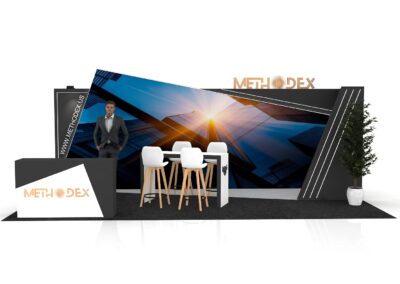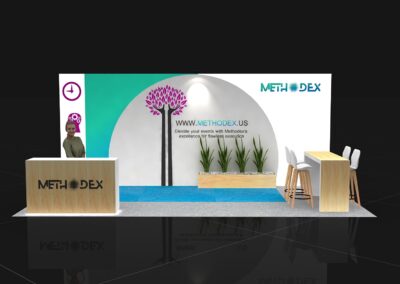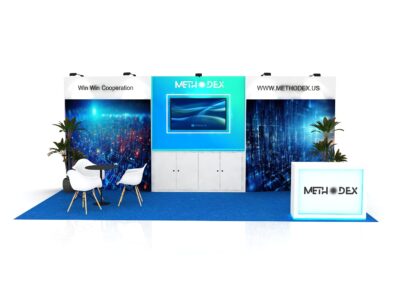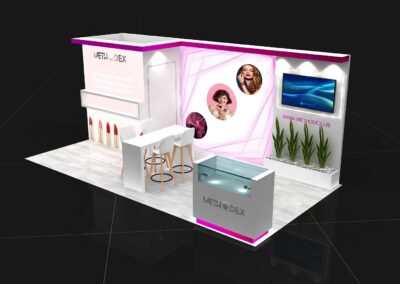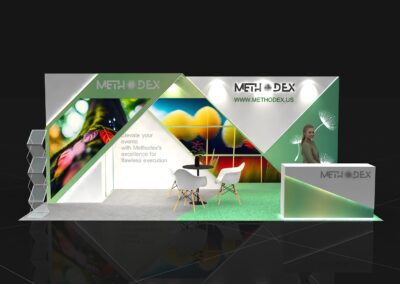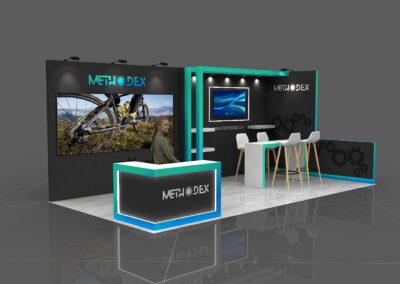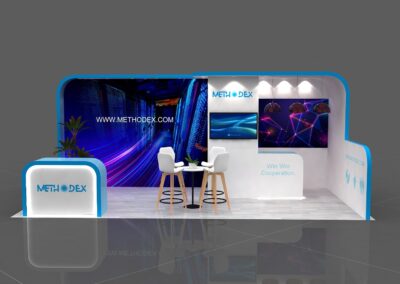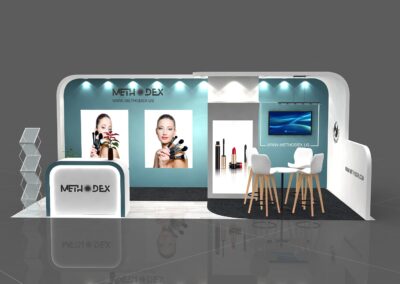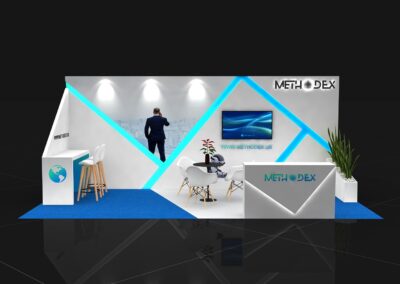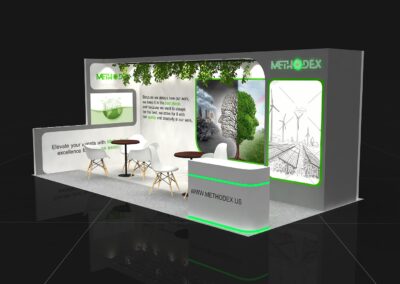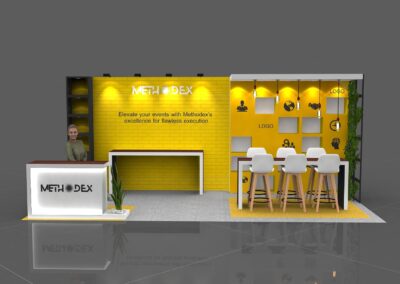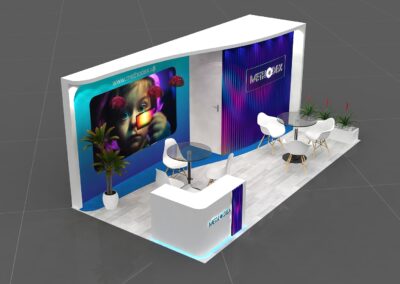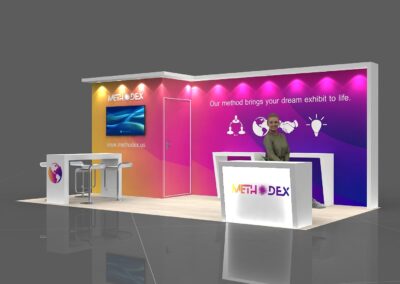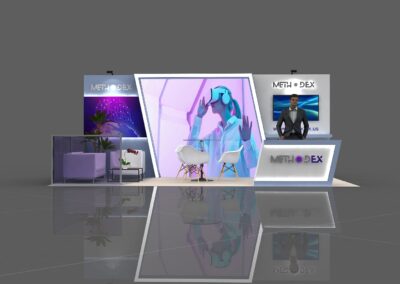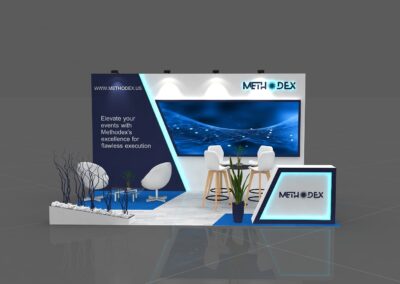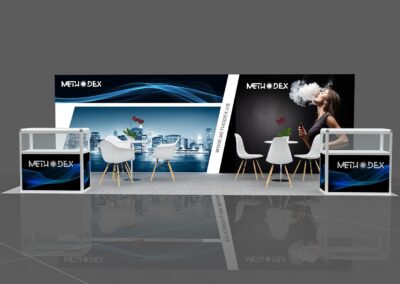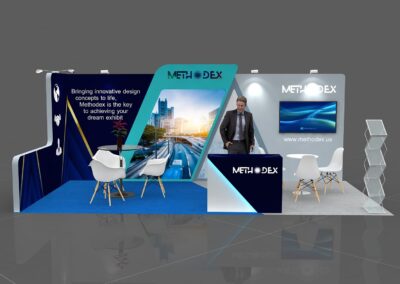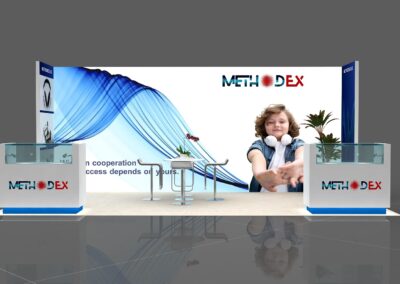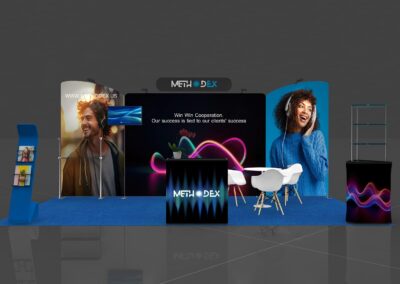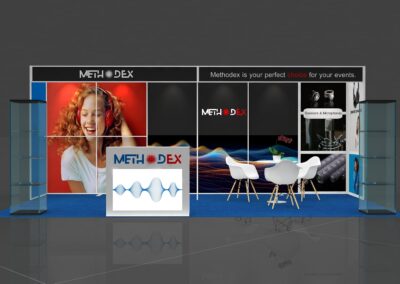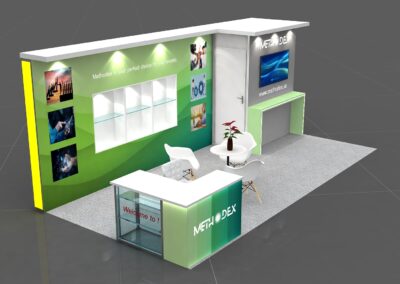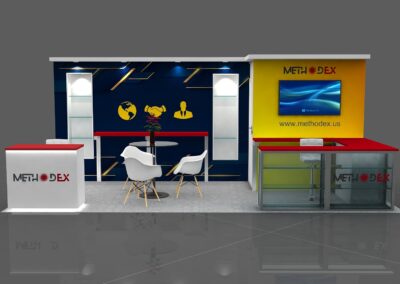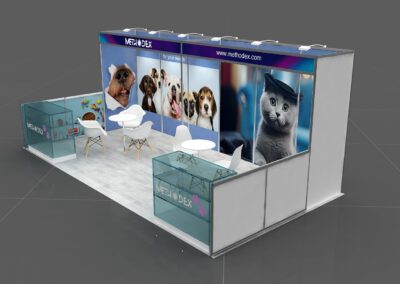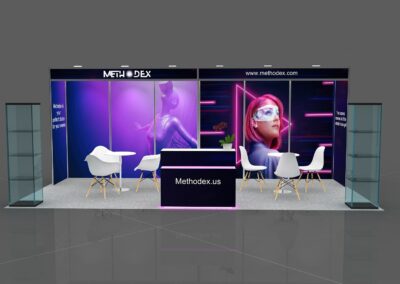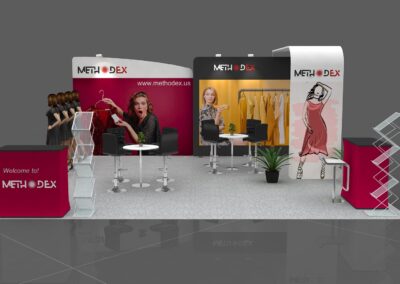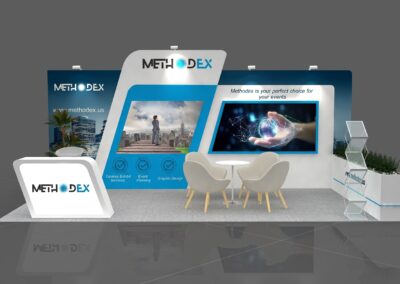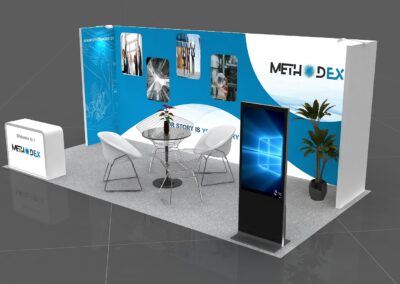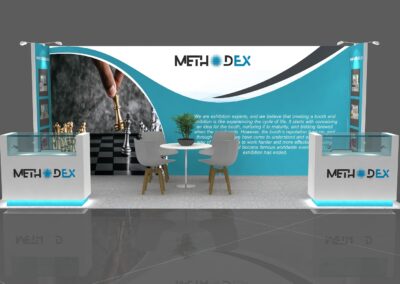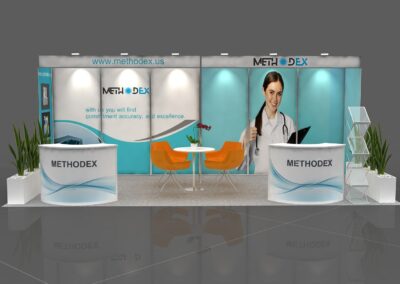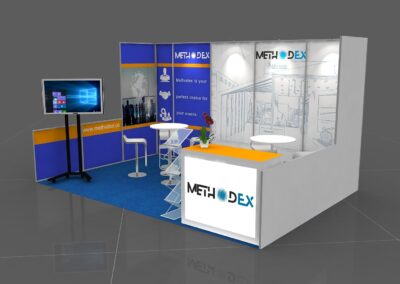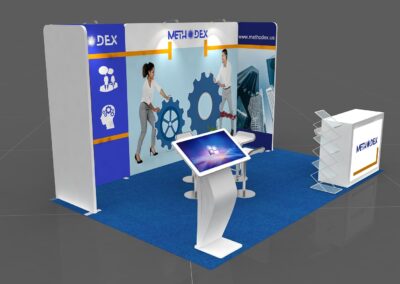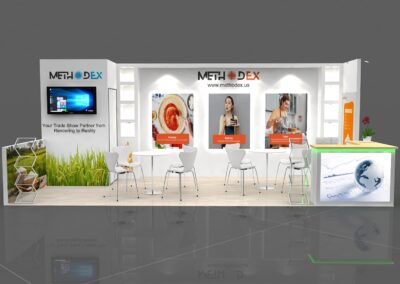
Start Here: Choose the Right 10x20 Booth
A 10x20 booth gives you enough space for stronger branding, product displays,
demos, meetings, and better visitor flow. But the right design depends on your
goal, budget, and how you want people to interact with your booth.
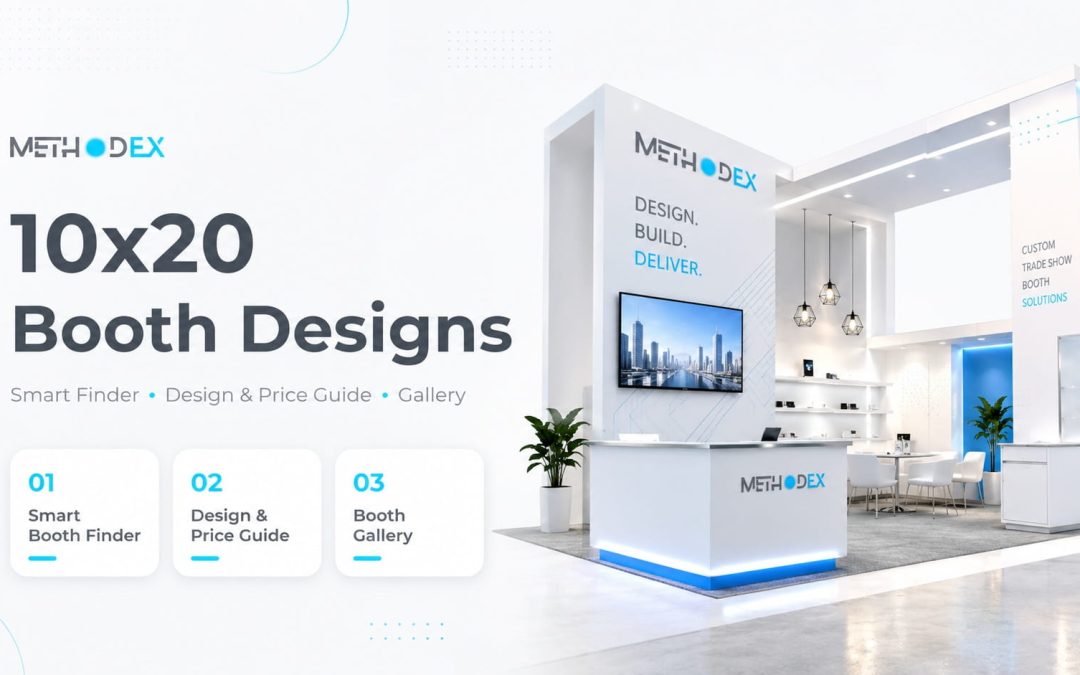
1. Smart 10x20 Booth Finder
Answer a few quick questions and get a recommended booth style for your show.
2. Complete 10x20 Design & Price Guide
Learn common layouts, design options, rental vs. custom choices, and what affects
the final cost.
3. 10x20 Booth Design Gallery
Explore real booth styles and product options to find inspiration for your next
trade show.
Which 10x20 Booth Is Right for You?
Answer 5 quick questions and get a recommended booth style based on your show goal, budget, layout needs, and visitor experience.
Top 10 Creative 10×20 Booth Designs to Elevate Brand
Most exhibitors waste their 10×20 footprint. They fill it with the same tension fabric backdrop every other company uses, point a single spotlight at it, and wonder why foot traffic keeps walking past. The problem is not the budget — it is the decision. A 10×20 booth is one of the most versatile formats on any show floor, but only when the display, the layout, and the design type are chosen with a clear purpose.
This guide does two things. First, it breaks down the 10 best 10×20 booth products available right now — with real prices, honest setup expectations, and a direct answer to who each one is actually right for. Second, it covers the 10 design approaches that determine whether a booth attracts visitors or just fills space. By the end, you will know exactly which direction fits your brand, your event schedule, and your budget.
Table of Contents
- Why the 10×20 Format Works
- Top 10 Best 10×20 Booth Products
- Lux Tower Display Kit — $6,734
- Wavelight Casonara 360 — $6,285
- Tahoe Twist-Lock Modular Wall — $4,099
- Brite-Lite Modular Lightbox — $3,958
- Hybrid Pro Modular Display — $11,795
- Vector SEG Modular Booth — $4,129
- Formulate Serpentine Curve — $2,929
- Tension Fabric Display Venus — $4,568
- Modular Wall with Monitor & Shelves
- Waveline 10×20 Display
- Top 10 Creative 10×20 Design Types
- Frequently Asked Questions
Why the 10×20 Format Is the Most Effective Starting Point for Serious Exhibitors
A 10×10 inline booth forces you to make compromises. There is room for a back wall and a table, and not much else. A 20×20 island booth requires a significant budget and a larger team to run it effectively. The 10×20 sits in between — big enough to create distinct zones within the space (one for display, one for conversation, one for demos), small enough to manage with two or three people and a reasonable budget.
The extra 100 square feet compared to a 10×10 is not just physical — it is psychological. Visitors perceive a 10×20 booth as an established, serious presence on the show floor. That perception happens before anyone reads your signage or talks to your team. If you have been exhibiting with a compact single-panel setup and feeling invisible at larger shows, the jump to a 10×20 format is usually the single change that makes the biggest difference. For a side-by-side look at smaller format options before making that call, the 10×10 exhibit booth ideas guide covers what is achievable at that scale and when it makes sense to stay there.
Top 10 Best 10×20 Trade Show Booth Products
Every product below is evaluated on four things: visual impact from a distance, realistic setup time for a two-person team, total value relative to price, and which type of exhibitor it actually suits. The price shown is the starting point — custom graphics and add-ons affect the final number.
1. Lux Tower 10×20 Trade Show Booth Display Kit — $6,734
Best for: brands that need premium presence at major expos without a custom build budget.
The Lux Tower uses backlit tension fabric graphics — the same illumination technology you see in airport lightboxes — which means your brand glows visibly across a crowded hall even when every booth around you is competing for the same attention. The frame uses a tent-pole assembly system that most two-person teams can complete in under 15 minutes, and the wheeled hard case the kit ships in converts into a podium on-site, so you are never carrying more than you need.
What sets it apart from cheaper backlit options is the washable, wrinkle-resistant fabric. After a long multi-day show, your graphics look the same on day three as they did when you set up. Add-ons include LED spotlights, shelving, and TV mounts — useful for brands that want to layer in product display or video without switching to a different system.
Skip it if: your budget is the primary constraint or you only exhibit once a year. The $6,734 price point makes most sense when you are attending three or more shows annually and need the display to perform consistently each time.
- Backlit tension fabric — washable and wrinkle-resistant
- Tool-free tent-pole assembly, under 15 minutes for two people
- Hard case converts into a podium at the event
- Optional LED spotlights, shelving, and TV mounts
2. Wavelight Casonara 360 Backlit Display — $6,285
Best for: corner and island booth locations where visibility from multiple directions matters.
Standard backlit displays illuminate from the front only. The Casonara 360 wraps illumination around the entire structure, so your brand message reads clearly whether a visitor is approaching from the aisle, the side, or directly in front. The curved frame creates a softbox-style glow — even illumination with no hot spots — that makes colors appear richer than they do on any flat-panel alternative at this price.
Setup is straightforward: the lightweight aluminum frame assembles without tools and the tension fabric snaps into place. If you are investing in a display at this price point, pairing it with a planned trade show booth lighting strategy — particularly spotlights on any product or demo areas within the booth — will extend the visual impact beyond what the backlit structure alone delivers.
Skip it if: your booth is a standard inline location against a wall. The 360-degree visibility is only a meaningful advantage when visitors can approach from more than one direction.
- 360-degree backlit visibility — effective from all approach angles
- Curved lightbox for even, glare-free illumination across graphics
- Lightweight aluminum frame with snap-in tension fabric
- Compact pack-down for a busy multi-show schedule
3. Tahoe Twist-Lock Modular Wall Display — $4,099
Best for: companies that exhibit at multiple shows with different booth sizes throughout the year.
The Tahoe's primary advantage is not its appearance — it is its adaptability. The twist-lock frame requires no tools, which means it can be assembled by any team member regardless of trade show experience. More importantly, the modular structure lets you add or remove acrylic wings, a canopy trim, and tables depending on the space available at each specific event. You are not locked into a single configuration.
For a brand that attends six shows a year, three of which have different floor plan dimensions, buying a fixed-configuration booth means either leaving space empty or cramming the display into a space it was not built for. The Tahoe solves that problem practically. The clean straight lines work across most industries — this is not a statement design, but it is a consistently professional one.
Skip it if: you only attend one or two events per year at the same venue size. The adaptability benefit does not justify the cost over a simpler system in that scenario.
- Tool-free twist-lock assembly — any team member can set it up
- Optional acrylic wings, canopy trim, and table configurations
- Reconfigurable for different event footprints
- Professional straight-line aesthetic for most industries
4. Brite-Lite Modular Lightbox Display — $3,958
Best for: brands that need backlit quality at a mid-range price with flexibility to scale.
The Brite-Lite uses edge-lit LED technology — lights embedded along the perimeter of the frame rather than behind the graphic — which produces consistent illumination across the entire surface without the uneven glow that affects cheaper backlit panels. The silicone edge graphic (SEG) system holds the fabric tight and frameless, giving the display a refined look that punches above its price point.
Because the system is modular, panels can be added as your booth budget grows. A company starting with a simple back-wall configuration can add side panels, towers, or a counter later without replacing the hardware. That makes the initial investment feel lower-risk than a fixed system at a similar price.
Skip it if: your graphics change frequently. While replacement fabrics are available, the SEG system requires graphics to be cut precisely — something to factor into the ongoing cost if your messaging updates often.
- Edge-lit LED for consistent, even illumination across the full surface
- SEG system delivers a seamless, frameless graphic finish
- Modular — add panels and components as your setup grows
- Strong performance in low-overhead-light convention environments
5. Hybrid Pro Modular Display — $11,795
Best for: established companies competing at national expos where the floor is full of large, well-funded exhibitors.
The Hybrid Pro is the most expensive product on this list and the one that requires the least justification when the context is right. Built-in monitor and digital signage support means you can run product videos, live presentations, or rotating content throughout the event without any aftermarket modifications or cable management workarounds. The modular panel system has a high-gloss finish that photographs extremely well — relevant if your team is capturing content for social media during the show.
At this investment level, the expectation is that the booth pays for itself through leads generated across multiple events. If you are considering whether a modular system makes sense for your long-term trade show strategy, the modular trade show displays guide covers how these systems compound value over time compared to fixed-structure alternatives.
Skip it if: you are a first-time exhibitor or attend only smaller regional shows. The Hybrid Pro is a significant investment that makes sense when the event scale and competitive environment demand it.
- Native monitor and digital signage support built into the structure
- High-gloss modular panels — strong visual presence and photography
- Fully customizable configuration per event
- Durable construction built for repeated high-frequency use
6. Vector SEG Modular Trade Show Booth — $4,129
Best for: design-led brands where graphic quality is a non-negotiable part of the brand identity.
Most display frames are visible. On the Vector SEG, they are not. The silicone edge graphic system works by tucking a thin silicone bead — sewn into the perimeter of the fabric — into a groove on the frame, which holds the graphic completely taut and frameless. The result is a gallery-quality presentation surface with no clips, no tension wrinkles, and no visible hardware breaking up the design.
For fashion, beauty, architecture, and lifestyle brands where the graphic is the primary communication tool, this matters. A display that introduces visible mechanical elements into a carefully designed composition undermines the work that went into the creative. A backlit version is available as an upgrade for events with challenging lighting conditions.
Skip it if: your graphics are text-heavy or primarily functional. The SEG system's advantages are most visible when the creative uses full-bleed photography or illustration — simpler graphics do not benefit as noticeably.
- SEG system — completely frameless, wrinkle-free graphic surface
- Modular structure adaptable to different event layouts
- Backlit version available for low-light environments
- Best results with high-quality full-bleed photography or illustration
7. Formulate Master Serpentine Curve Fabric Backwall — $2,929
Best for: first-time exhibitors and growing brands that want to look different without spending like an established company.
Every other back wall on this floor is flat. That is the entire argument for the Serpentine Curve. The gentle S-shape creates natural depth within the booth footprint — the kind of visual interest that a flat panel simply cannot produce regardless of how strong the graphic is. It also functions as a natural backdrop for product demonstrations and on-site photography, because the curve eliminates the flat, corporate look that straight walls tend to produce in photos.
At $2,929, it is the most affordable product on this list. The lightweight aluminum frame and tension fabric system means one person can set it up in under 20 minutes. For a company making its first significant trade show investment, this is the option that looks the most distinctive relative to its cost.
Skip it if: your brand identity is strictly straight-line geometric. The organic curve is a strong visual statement that needs to align with the overall brand aesthetic to feel intentional rather than arbitrary.
- Serpentine S-curve creates depth that flat panels cannot replicate
- Lightweight aluminum frame — single-person setup under 20 minutes
- Effective product demo and photography backdrop
- Most affordable differentiated option on this list at $2,929
8. 10×20 Tension Fabric Display Venus — $4,568
Best for: companies that travel frequently between events and need a professional display that stores and ships compactly.
The Venus does not try to be the most dramatic display in the room. It tries to be the most reliable one — and for a certain type of exhibitor, that is exactly what matters. Dye-sublimation printing produces photographic-quality color that holds up across many events without fading or losing saturation. The tension fabric pulls cleanly over the frame with no visible creases, and the lightweight build means the entire display ships without oversized freight costs.
For companies with five or more events per year spread across multiple cities, the cumulative shipping and handling costs of heavier display systems add up quickly. The Venus absorbs that variable more efficiently than most alternatives at this price.
Skip it if: your event schedule is concentrated at one or two large annual shows where the investment in a backlit or modular system would pay off more clearly.
- Dye-sublimation print — photographic quality color across many uses
- Wrinkle-resistant tension fabric with a clean flat finish
- Lightweight and compact — low shipping costs for frequent travelers
- Consistent professional appearance at a mid-range price
9. 10×20 Modular Wall Display with Monitor Mount and Shelves
Best for: product brands where physical samples and video content need to work together in the same space.
This setup combines a back wall structure with integrated shelving and monitor mounts in a single 10×20 configuration. The result is a booth that functions as a complete presentation environment — products visible on shelves at eye level, a screen running a demo or explainer video overhead, and branded graphics framing the whole thing. It operates without constant staff intervention, which matters during busy periods when your team is occupied with multiple conversations at once.
The modular construction means individual components — shelves, monitor positions, panel arrangements — can be reconfigured as your product line changes or as you adapt the booth for different event formats. Contact us for pricing on this configuration.
Skip it if: you are a service business without physical products to display. The shelving and monitor mount combination adds complexity and cost that only pays off when there is genuine product to show.
- Integrated monitor mounts — no aftermarket modifications needed
- Built-in shelving for physical product and collateral display
- Self-contained presentation environment — works without constant staffing
- Modular components — reconfigure as product line or event format changes
10. Waveline 10×20 Trade Show Display
Best for: small businesses and startups that need to look established on a limited first-year budget.
The Waveline wraps stretch fabric over an aluminum extrusion frame on all sides, hiding every piece of hardware and creating a clean enclosed structure that looks more deliberate than its price suggests. There are no exposed poles, no visible feet, and no hardware breaks in the branded surface — just a seamless modern exterior. Setup requires no tools and can be completed by one person, which helps when event day logistics are already stretched.
For a company spending its first significant trade show budget, the Waveline provides the visual baseline needed to be taken seriously on the floor without committing to a system that leaves no budget for graphics, giveaways, or staffing. If you are comparing this against a 10×10 trade show booth as a starting point, the Waveline's enclosed design in the larger footprint is typically the more impactful investment for brands ready to take trade shows seriously. Contact us for current pricing.
- Fully enclosed stretch-fabric design — no exposed hardware
- Tool-free single-person setup
- Clean modern appearance at a budget-accessible price
- Right entry point for brands new to the 10×20 format
Top 10 Creative 10×20 Booth Design Types — And When Each One Actually Works
The product you choose gives you the structure. The design type determines what experience visitors have inside it. These are not equally good choices for every brand — each approach has a specific context where it outperforms the alternatives, and an honest assessment of when it does not.
1. Minimalist Booth Designs
One dominant visual. One clear message. Open floor space that feels intentional rather than empty. Minimalist design works when the brand is already recognizable enough that it does not need to explain itself — financial services, enterprise software, premium consumer goods. The mistake most exhibitors make with minimalism is confusing it with underfunding. A genuinely minimal booth requires more deliberate design decisions, not fewer. Every element that remains needs to earn its place.
2. Tech-Driven Booth Designs
Touchscreens, product configurators, AR stations, and live data displays turn the booth from a display into a destination. Visitors who interact with something spend more time in the space and remember the experience more clearly than visitors who simply read a panel. This approach works best for software companies, hardware brands, and businesses whose product is difficult to communicate through static graphics alone. The risk is over-engineering — one interactive element done well outperforms three half-functioning ones. Choose a modular display base that supports integrated screens without workarounds; the Hybrid Pro is built for exactly this use case.
3. Eco-Friendly Booth Designs
Recycled materials, LED-only lighting, and reusable structural components communicate a brand's values before a single conversation begins. This is not just messaging — it is material evidence of a commitment that an audience can observe directly. For brands in wellness, food, outdoor, and sustainability sectors, the design consistency between what you say and how your booth is built carries genuine credibility weight. It also reduces the total cost of exhibiting across multiple shows, since reusable components eliminate the build-and-dispose cycle.
4. Immersive Experience Booth Designs
An immersive booth creates a distinct environment — visitors step out of the convention hall and into a branded world. Custom lighting, thematic props, curated sound, and a deliberate traffic flow guide visitors through a sequence that builds an emotional connection rather than communicating a list of features. These booths generate the most social sharing and the strongest post-event recall. They also require the most investment and the most planning. If immersive is the goal but the budget is constrained, the 10×10 exhibit booth ideas guide covers how to create atmosphere and engagement at a smaller scale and lower cost as a proving ground before committing to a full 10×20 build.
5. Product-Centric Booth Designs
When the product is the strongest argument for the brand, the booth should stay out of its way. Product-centric designs put the item front and center — on shelves, in live demo zones, or in hands-on sample areas — with the surrounding structure acting as a clean frame. Visitors who can touch, test, or see a product working live convert to qualified leads at a higher rate than those who receive a brochure. This approach is particularly effective at product launches and for consumer goods brands at industry buying shows.
6. Multi-Level Booth Designs
Vertical space is the most underused asset in a 10×20 footprint. Elevated platforms, hanging overhead signage, and double-deck configurations make a booth visible from across the hall — particularly important at large expos where sightlines are blocked by competing exhibits. Multi-level designs work best for companies with the staff to utilize the different zones effectively. An elevated level that sits empty during the show undercuts the effect. Dedicated booth lighting on upper levels is essential — an upper platform that falls into shadow looks more like a construction error than a design decision.
7. Branded Environment Booth Designs
A branded environment applies brand guidelines to every surface — floor wraps, furniture finishes, staff attire, and even the type of refreshments on the counter. The consistency communicates a level of organizational discipline that visitors register subconsciously before any conversation begins. This approach is most effective for companies where brand recognition is already established and the goal at the event is deepening relationships with existing contacts rather than introducing the brand to new audiences.
8. Interactive Booth Designs
Games, contests, live polls, social media walls, and hands-on product activities give visitors a reason to stop that requires no persuasion from the team. Participation naturally extends dwell time, which increases the number of meaningful conversations per event. The data capture opportunity is also significant — a participation mechanic that requires an email or badge scan to enter generates leads without the friction of a direct ask. The formats that perform best are simple enough to understand in under ten seconds and rewarding enough to complete. Overly complex interactive setups create confusion and foot traffic avoidance, not engagement.
9. Modular Booth Designs
A modular approach treats the booth as a system rather than a single fixed object. Panels, counters, towers, and accessories connect through a consistent hardware architecture that allows the configuration to change per event. This matters because most brands do not exhibit at the same venue in the same size footprint every time. A modular system adapts. A fixed booth does not. For a detailed look at how these systems work, what they cost over multiple events compared to purchasing fixed structures, and which configurations suit different industries, the modular trade show displays guide is the right starting point.
10. Bold and Bright Booth Designs
High-contrast color palettes, oversized typography, and unexpected visual compositions stop foot traffic without requiring any verbal invitation. In a convention hall where the default is navy, gray, and white with a logo in the center, a booth with genuine visual confidence becomes the landmark that attendees navigate toward and reference when discussing the show afterward. The execution requires discipline — bold done well is intentional and on-brand; bold done poorly is chaotic and forgettable. The test is whether the design still clearly communicates the brand when viewed from 30 feet away at an angle.
Frequently Asked Questions About 10×20 Booth Designs
How long does it take to set up a 10×20 trade show booth?
Most tension fabric and twist-lock systems on this list can be set up by two people in 20 to 40 minutes. More complex modular configurations with monitor mounts and shelving typically take 45 to 90 minutes. Backlit systems with multiple tower sections run closer to 30 to 60 minutes depending on the number of panels. If setup time is a hard constraint at your events, look specifically at the Serpentine Curve, the Tahoe Twist-Lock, and the Waveline — all three are designed for fast single or two-person assembly.
Is a 10×20 booth worth it compared to a 10×10?
At smaller regional shows with under 100 exhibitors, a well-designed 10×10 can perform just as well and at lower cost. At larger national expos with 300 or more exhibitors, the 10×20 footprint provides a meaningful visibility and credibility advantage. The decision should be based on the scale of the events you attend, not the size of your company. A startup at a major industry expo is better served by a strong 10×20 display than an established company with a weak 10×10 presence.
Do I need backlit graphics for a 10×20 booth?
Not necessarily — but lighting matters more than most exhibitors realize. Non-backlit displays perform well in convention halls with strong, consistent overhead lighting. In older venues or large exhibit halls where overhead lighting is uneven and dim, non-backlit graphics can appear flat and easy to overlook. If you are not going backlit, a targeted external lighting plan — spotlights aimed at key graphic areas — can compensate significantly. The trade show booth lighting guide covers exactly how to approach this decision based on your specific event environments.
Can I use the same 10×20 booth at different events?
Yes, and this is one of the primary arguments for investing in a quality system rather than a one-time rental. The fabric graphics on most of the systems listed here are washable and designed for repeated use across dozens of events. Modular systems give you additional flexibility because the configuration can change per show — useful when different venues allocate different footprints. The hardware investment is made once; the only recurring cost is replacement graphics when your messaging changes.
What is the most cost-effective 10×20 booth for a first-time exhibitor?
The Formulate Master Serpentine Curve at $2,929 is the most affordable product on this list that still looks genuinely distinctive on the floor. The Waveline is a strong second choice for a company that wants a clean enclosed look without the curve aesthetic. Both options leave enough budget to invest in professional graphics, which ultimately matter more than the hardware at entry level. A strong graphic on a simple frame outperforms a premium frame with weak creative every time.
Build a 10×20 Booth That Actually Stops Foot Traffic?
The difference between a booth that generates leads and one that gets walked past is almost never budget. It is decisions — the right display system for the right events, a design approach that matches the brand and the audience, and a lighting setup that makes the graphics work in the actual hall environment rather than in the catalog photo. Every product on this list is customizable, and every decision is worth making deliberately.
If you know which direction you are leaning, request a free quote and we will put together a detailed proposal for your specific event schedule. If you are still comparing options, the pages on modular trade show displays and trade show booth lighting cover the two decisions that most exhibitors get wrong and that have the biggest impact on results.