
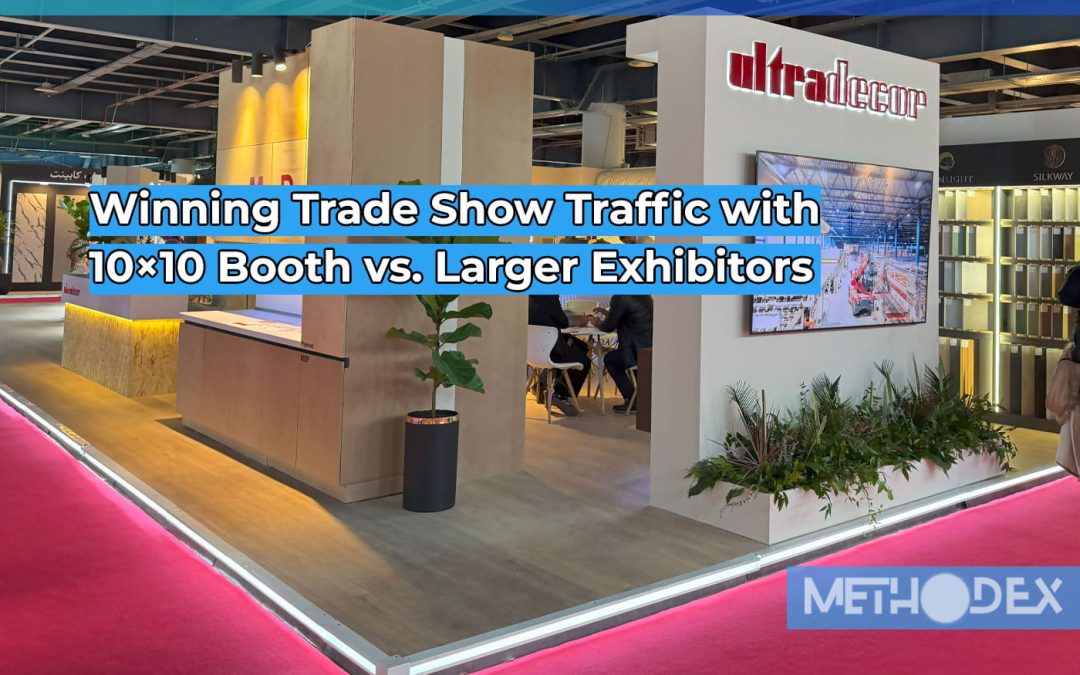
Winning Trade Show Traffic with a 10×10 Booth vs. Larger
Stepping onto the floor of a major trade show can be a deeply daunting experience for a small or medium-sized business. You’ve carefully budgeted for a 10×10 (30-foot) linear booth, planned the logistics, and flown your best sales team across the country. But as soon as the doors open, the psychological reality sets in: You’re standing right in front of an industry giant with a custom-built 40×40 (150-foot) island booth; complete with giant hanging signs, a barista serving up hand-crafted espresso, and a team of 20 sales reps. The first instinct of many marketing executives is panic. How is a 30-foot space supposed to compete for attention with a multi-million dollar marketing budget?
The answer lies in a fundamental misunderstanding of “show physics.” In event marketing, sheer volume does not equal high ROI. Mega-booths often suffer from the “terminal effect”; they are incredibly busy, but the vast majority of that traffic is low-quality visitors looking for free coffee or a place to sit. Interactions are superficial, transactional, and quickly forgettable.
In contrast, a 10×10 Trade Show booth has a unique strategic advantage: Intimacy and Density.
If engineered correctly, a small space is forced to create highly focused, high-quality interactions. You’re not trying to attract everyone; you’re trying to magnetically attract exactly the right buyers and create an environment where distractions are minimized and deep “consultative selling” can happen.
To achieve this, we can’t rely on the old “set up a table and wait” playbook. We need to combine insights from three distinct fields:
- Behavioral psychology: Understanding how the human brain filters information in high-speed environments.
- Big business strategy: Adapting the high-level tactics of Fortune 500 companies to small, agile frameworks.
- Digital and social mechanics: Harnessing viral, dopamine-driven engagement loops (like YouTube and TikTok) .
This comprehensive classroom breaks down 5 multidisciplinary strategies to turn your 10×10 booth into a high-density lead generation machine.
Strategy 1: Trade Show Giveaways to Increase Booth Engagement and Lead Quality

Leaving a bowl of cheap pens and stress balls at your booth is a big missed opportunity to generate leads. This old approach sticks around out of habit, not because it works.
- Giveaways in 10×10 trade show both Work : Dr. Robert Cialdini’s book Influence explains that people naturally want to return favors. But research shows that if a giveaway feels cheap or is handed out to everyone, people feel no need to give anything back. They just grab the item and move on.
- Tiered Giveaway for Maximum Trade Show Leads : Top trade show exhibitors don’t hand out their best items to everyone. They use a careful, tiered system. If you have a small booth and a limited budget, you should do the same to get the most value.
Low-Cost Booth Giveaways That Attract Walk-Up Traffic
These items aren’t on the table; they’re in your employees’ hands or pockets. They’re used solely to stop a customer on the move. Forget the pen. In 2026, “use” is king. Think: branded webcam covers, high-quality nano wipes for cleaning screens, or electrolyte (Liquid IV) sachets. Script: “It looks like you’ve been walking for hours. Grab one of these hydration packs. By the way, what industry are you looking at today?”
Mid-Value Giveaways for Lead Capture and Badge Scans
These items are visible but not available without a “deal.” They’re stored behind your counter. To obtain this item, the visitor must allow a badge scan and answer three qualitative questions. Examples: premium Moleskine notebooks, high-wattage power banks, or items on display that are not just for anyone to take. They’re kept behind your counter. To get one, visitors need to let you scan their badge and answer three questions. These are your top prizes. Bring only 10 to 15 for the whole show. Save them for the best leads—people who agree to a follow-up call or meeting.
Using Mystery Box Giveaways to Boost Social Sharing
YouTube and TikTok are dominated by “Unboxing” and “Mystery” content. Humans are biologically addicted to “variable reward programs” (the same psychology behind slot machines). You can take advantage of this in a 10×10 booth. Instead of handing someone a power bank, place a clear acrylic “safe” on the counter. Rather than just giving away a power bank, put a clear safe on your counter with a top prize inside, like an Apple Watch or headphones. After a demo, hand the customer a key or code. If it opens the safe, they win. You have successfully created a local viral moment in a 30-foot space.
Strategy 2: Interactive Booth Games and Demos
Traditional B2B trade show interactions often lack engagement. Prospects typically receive a standard elevator pitch, making it difficult for your company to stand out among many similar presentations.
Why Interactive Booth Experiences Outperform Passive Displays
Educational psychology and Cognitive Load Theory have long established that passive learning (listening to a presentation) has a very low retention rate. Active learning—where the subject physically or cognitively interacts with the material—exponentially increases retention and positive brand associations. When a user engages with gamification. Large brands may invest heavily in immersive VR or large-scale physical games. For most exhibitors, a visually appealing, seamlessly integrated digital gamification is more practical and effective. Instead of a bunch of brochures, mount a high-quality tablet on a stylish stand at the edge of the booth.
Using an Interactive ROI Calculator to Qualify Booth Visitors
If you sell B2B services or software, create a simple, engaging touchscreen calculator. “Swipe to see how much time you’re wasting manually entering data.” The customer enters three numbers, and a screen displays their potential savings. They’ll need to enter their email address to email themselves a detailed report. You just captured a high-quality lead through “interactive self-service.”
Digital Scratch-Off Games and Leaderboards for Lead Capture
If your goal is sheer volume, use software to create a “scratch-off” game on a tablet. Hook the tablet up to a larger monitor on the back wall. As people play, their scores or names appear on a “daily leaderboard” at the top. Humans are fiercely competitive. Visitors will return to your booth just to see if their name is still at the top of the leaderboard.
Creating Social Media–Ready Interactive Booth Experiences
If you want to understand how to drive traffic, look at “experiential marketing” activities on Instagram. The goal is to make the engagement so visually compelling that the user will want to record it. If you have a physical product, don’t just let it sit on the shelf. Create a “torture test.” If your product is durable, set up a station where visitors can try to break it. If it’s software, set up a “race against the machine” challenge where the visitor tries to do a task manually faster than your software. Implementation Tip: Choosing the right modular fixtures is crucial to executing this without going over budget. Check out our analysis of How to Display Products in a 10×10 Booth on a Budget to find cost-effective tech stands and counters.
Strategy 3: Engagement Techniques for 10×10 Booth
The most beautiful booth in the world is completely useless if the staff who man it behave like museum guards. The human factor is the key variable that dictates whether a 10×10 booth succeeds or fails. Because your physical footprint is small, your energy footprint must be huge.
Using Body Language and Booth Positioning to Attract Attendees
In the study of nonverbal communication, proxemics is the study of how humans use space, and kinesics is the study of body language. Exhibition aisles are considered “public areas.” When a visitor walks down an aisle, his psychological defenses are up. If your staff is standing behind a covered table (a physical barrier) with their arms crossed (a closed kinesic signal), the subconscious message being sent to the visitor’s brain is: “Don’t come close; we’re protecting our territory.” Conversely, standing on the edge of the carpet (the threshold between the public and social areas) with an open body posture invites people to come closer. High-performing commercial sales teams don’t rely on improvisation. They use well-designed “aisle intercept” scripts.
Common 10×10 Trade Show Conversation Mistakes
: Never let your staff say:
* “Can I help you?” (Answer: “No, I’m just looking.”)
* “How are you?” (Answer: “I’m fine, thanks.” Continues walking)
* “Would you like to hear about our new software?” (Answer: “I don’t have time, sorry.”)
Challenger Approach: According to the Challenger sales methodology, your opening sentence should be a “Pattern Interrupt.” It should be a very specific, slightly provocative question that addresses a known industry pain point.
* Example 1 (Curiosity): “Quick question—are you guys still using competitor’s outdated technology for your logistics, or did you finally make the switch?”
* Example 2 (Visual Prop): Hold up a physical item (even a piece of your product). Hold it out slightly toward a passing customer. “Ever feel how light this composite material is?” Human reflex dictates that if you point something at someone, they will instinctively reach out to grab it. Once they have it in their hand, they should stop. You now have 30 seconds to present.
if you want to know better about controlling crowd in trade show booth you can read this post
Strategy 4: Trade Show Booth Lighting and Visual Design
In a crowded convention center, attendees are subject to “sensory overload.” Thousands of colors, logos, and sounds compete for their visual attention. If your 10×10 booth is drowned in visual noise, you’ll be ignored. You need to 10×10 design ideas for “disruption.”
Why Bright, High-Contrast Booth Designs Draw More Attendees
In biological terms, phototaxis is the bodily movement of a moving creature in response to light. Although humans are sophisticated, our reptilian brains are still instinctively drawn to bright, high-contrast light sources in dimly lit environments (like a conference room). Furthermore, cognitive psychology dictates that “visual salience”—the distinctive visual quality that sets an item apart from its neighbors—is achieved primarily through contrast, not just color. If all the booths around you are white and light blue, a matte-black booth with penetrating amber lighting will visually dominate the aisle.
How to Use Layered Lighting in a 10×10 Trade Show Booth
Commercial giants spend a fortune hanging lighting from the ceiling above their island booths. At 10×10, you need to bring the light down to eye level and create “layered” lighting.
How to Avoid the “Dark Booth” : Never rely on overhead lighting in the hall. It casts harsh shadows on your graphics and your employees’ faces.
Using Backlit Graphics: As we’ve detailed in our 10×10 Exhibition Booth Design Guide, stretch fabric displays with backlit (SEG) are the ultimate visual disruptor. Instead of shining light on the banner, the light is emitted from within the graphic. It’s like the glow of a giant phone screen that the modern human eye is hopelessly addicted to looking at.
10×10 Trade Show Booth Kinetic Lighting: Steady light is good; moving light is magnetic. Use programmable LED strips hidden under counters or along the back wall edges that gently pulse or change color. Human peripheral vision is highly sensitive to movement. A subtle pulse can cause passersby to involuntarily turn their heads.
Designing a Photo-Worthy Booth Backdrop for Social Media Sharing
When designing your booth graphics, apply the same logic you use to design YouTube thumbnails.
Amateur exhibitors treat the back wall like a brochure, filling it with bullet points, a mission statement, and a font size 12. A YouTube thumbnail has a high-contrast image, a highly emotional human face, and no more than 4-6 words of text. Your back wall should be exactly that. If a visitor takes a photo of your booth to post on social media, your core value proposition should be instantly readable on a 6-inch mobile screen. Keep it clear, bold, and minimal. Actionable Tip: If you’re not sure which structure best supports this visual strategy, check out our 10×10 Trade Show Booth Types Comparison to weigh the benefits of pop-up frames vs. modular aluminum extrusions.
Conclusion: How Small 10×10 Booths Can Outperform Larger Exhibits
You do not need to spend more to compete with large island booths. Instead, focus on smart strategies. Large booths often have high overhead, need more staff, and can lose focus on their brand messaging. Your 10×10 booth is a focused and practical tool. Use giveaways that encourage people to give back, add small games, get visitors involved in the aisle, use eye-catching visuals, and build trust with targeted pre-show marketing. These steps help you make the most of your smaller space. You are not simply a small vendor seeking visibility; you are a concentrated hub of value. While you may generate fewer badge scans than larger booths, your sales pipeline will contain highly qualified, engaged decision-makers. In exhibition ROI, density consistently outperforms volume. The strategy is clear and the psychological principles are proven. It is now time to implement.