
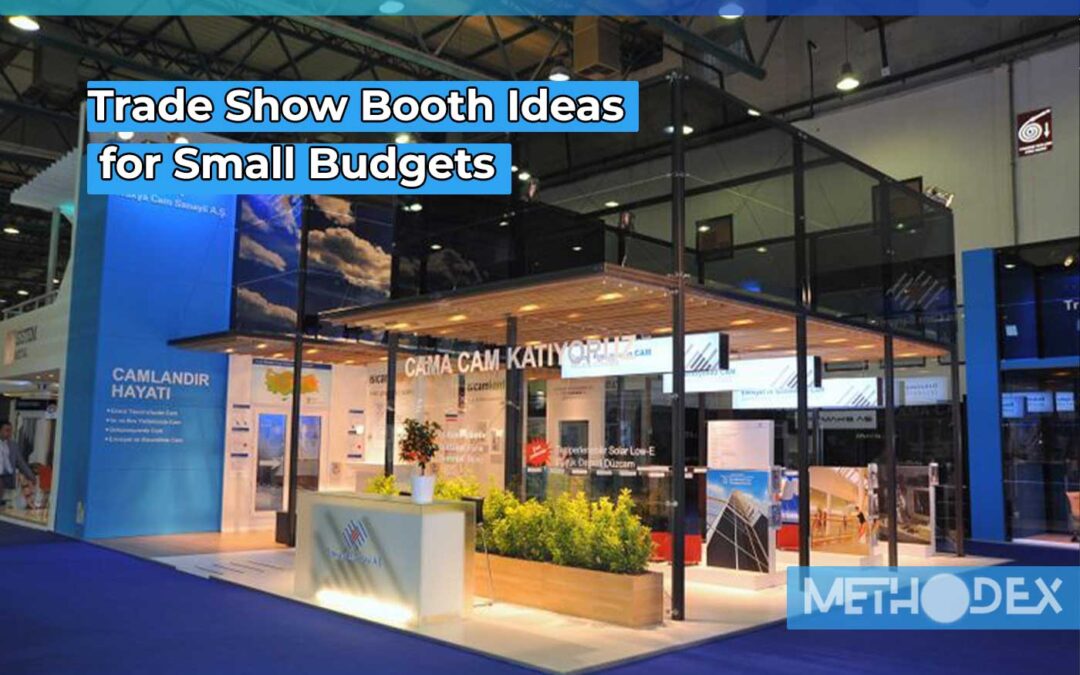
Booth space is the cost a small exhibitor can do the least about. CEIR’s How the Exhibit Dollar is Spent 2026 report found that exhibit space takes the largest share of exhibitor spending, 40.5 percent, up from 37.9 percent in 2017. It also found that exhibitors with the smallest marketing budgets put the largest share of their spending into core necessities: exhibit space, plus travel and entertainment for booth staff.
The trade show booth ideas for small budgets below focus on the costs you can control: how the booth is built, freight weight, show service deadlines, and setup labor. Most rates come from CES 2027 at the Las Vegas Convention Center (LVCC), so use them as a guide. The LVCC and Venetian Expo facility rules quoted here apply to every show in those buildings, and your show can add its own.
Where a Small Exhibit Budget Actually Goes
EXHIBITOR Magazine’s “Budget Breakdown” survey gives a lower figure than CEIR: 23 percent for booth space. The survey covered nearly 200 event marketers and ran in the August/September 2025 issue. Individual answers ranged from 15 percent to more than 50 percent. The samples are different, and EXHIBITOR notes that many companies report travel outside the exhibit budget, so treat the two as separate benchmarks.
| Category (EXHIBITOR, 2025) | Share of budget |
| Booth space | 23% |
| Show services | 18% |
| Exhibit design and construction | 16% |
| Shipping | 11% |
| Travel and lodging | 11% |
| Marketing promotions | 8% |
| Graphic design and production | 6% |
| Talent | 3% |
| Measurement | 2% |
| Other (including lead retrieval and staff uniforms) | 2% |
Show services, the catch-all line for items like internet and cleaning, held around 14 percent of budgets from 1998 to 2022 before rising to 18 percent. That puts it ahead of exhibit design and construction, which fell from roughly 23 percent in 1998 to 16 percent now. Much of the show services line depends on when you order.
The same EXHIBITOR article makes the case for preparation over square footage: “A well-thought-out 10-by-20 can easily outperform an underdeveloped 20-by-40.” For a line-by-line estimate, see our Las Vegas trade show booth cost guide. Our list of hidden trade show costs covers the charges that rarely appear in a first budget.
Low-Cost Design Ideas That Pass the Fire Marshal
At the LVCC, every material in the booth must be certified flame retardant or have a sample on hand for testing. That includes decorations and temporary covers. Anything that can’t be treated to meet the rule is not allowed. The Venetian Expo goes further: a manufacturer’s fire resistance certificate must accompany all materials. Nylon, oilcloth, and certain other plastics cannot be made flame retardant, so they are prohibited. A do-it-yourself build from hardware store pipe and foam board is a risk if you have no certificate to show the inspector.
Low-cost ideas that work within these rules:
- A 10×10 with one fabric graphic back wall and a single clear message. Keep the fabric’s flame-retardant certificate or a test sample on hand, as your venue requires.
- A modular frame you already own, refreshed with new branded graphics. The structure stays, and only the message changes.
- A rented 10×20 instead of a purchased one, if you exhibit only a few times a year. You get the larger footprint without building or storing a booth of your own.
- A minimalist, product-focused booth. Use a demo table for short, rehearsed demonstrations and focused lighting on the product, within your show’s rules for exhibitor-installed lighting. Tablets or QR codes in place of printed brochures also cut freight weight.
For layouts that make the most of a small footprint, see our guide to displaying products in a 10×10 booth within budget.
Think twice before adding a ceiling. At the LVCC, a canopy, ceiling, or overhead lighting installation that blocks the sprinklers counts as covered area. A booth plan is required for a single-level exhibit over 1,000 square feet, more than 300 square feet of contiguous covered area, or any multilevel exhibit. A single-level 10×10 or 10×20 stays under all three. But any covered area that is also enclosed needs battery-operated smoke detectors, whatever its size.
Balloons need approval too. At the LVCC, show management and the LVCC’s convention services manager must approve balloons, so ask show management first. Helium balloons must be tethered, and they may not be used as handouts. The Venetian Expo limits balloons to 36 inches in diameter and discourages mylar balloons.
Cut Freight Weight, Not Booth Quality
Material handling (drayage) is billed by weight. So every pound costs you twice: once to ship it, and again to move it from the dock to your booth and back. For CES 2027, the topline rate at the LVCC and Venetian Expo Halls A-D and G is $0.71 per pound, with a 100-pound minimum. At the LVCC, small CES 2027 shipments up to 30 pounds are free if they arrive the same day, from the same shipper, by the same carrier.
The rate also depends on the hall: the same CES 2027 topline table has $1.16 per pound for Venetian meeting rooms, Exhibit Suites, and ARIA. Rates are set show by show, and your material handling form has the real number.
To keep freight costs down:
- Choose fabric graphics and lightweight frames over hard walls and rigid printed panels. EXHIBITOR credits portable and modular systems with letting brands deliver “high-impact design without high-cost build.”
- Weigh every crate and case before it ships, and keep the weights to compare with your material handling invoice.
- Watch the minimum. At CES 2027, a 40-pound shipment misses the free 30-pound limit and is billed as 100 pounds. Trim it to fit the allowance, or hand carry it.
- Know the billing unit. Some shows quote material handling per CWT (hundredweight, or 100 pounds) instead of per pound. IMEX America 2026 at Mandalay Bay charged $122.25 per CWT for freight sent through the advance warehouse and $131.25 per CWT for freight shipped direct to the show site.
- Consolidate small shipments. The CES 2027 minimum applies to each shipment, so three 40-pound boxes sent separately are billed as 300 pounds ($213.00). Packed as one 120-pound shipment, they are billed as 120 pounds ($85.20).
Order Show Services Before the Deadline
Electrical and other exclusive services are ordered from the provider named in your exhibitor manual, and the price depends on when you order. At the LVCC for CES 2027, a 500-watt outlet is $115.35 at the advance rate and $173.05 at the regular rate, about 50 percent more. For CES 2027, the LVCC exhibitor manual set the utilities order deadline (November 25, 2026) a week before the general discount deadline (December 1, 2026), so electrical can close before everything else. Check both dates in your own manual.
Before you order anything, check what your booth already includes. At CES 2027, open exhibit space booths of 399 square feet and under come with 8-foot-high back wall and side wall drape and an 11×17-inch company identification sign. That covers a 10×10 and a 10×20. At the LVCC, booths in that size range also get two hours of complimentary electrical labor. CES also includes nightly vacuuming for exhibitors at the LVCC or Venetian Expo in open exhibit space or meeting rooms. Don’t order those items separately.
The Venetian Expo sets its own cutoffs for its exclusive services, such as electrical and internet; catering has separate terms. Orders placed at least 21 calendar days before opening day get a discounted rate. To qualify, full payment and completed CAD drawings must arrive by the same deadline. Rigging is excluded. Orders after that cutoff are billed at the standard rate, and orders received within 24 hours of opening are billed at the show-site rate. Put every deadline from your exhibitor manual on one calendar the week the manual arrives.
Late orders cost more on other lines too. SEMA Show 2026 at the LVCC listed material handling at $1.11 per pound for orders by its October 22 deadline and $1.39 per pound after it, about 25 percent more. At the Venetian Expo, catering orders received within 72 hours of opening carry a 10 percent increase. Each premium looks small alone, but across electrical, freight, and catering, they add up.
Set Up a Small Booth Yourself (Where Rules Allow)
Doing the setup yourself can remove most of the labor line. The LVCC Facility Guide (July 2026) allows it “if approved by show management.” The work must be done by full-time employees of the exhibiting company, who must show credentials and follow OSHA safety standards.
Your show’s exhibitor manual may add its own limits, so check it before you plan on doing the work yourself. If you hire labor from the official contractor, the CES 2027 topline rate is $98.50 per hour at straight time. Overtime is $157.85, about 60 percent more. Schedule any hired labor for straight time where you can. Methodex is authorized to work as an exhibitor-appointed contractor (EAC) at both the LVCC and the Venetian Expo, following each show’s EAC registration and certificate of insurance requirements, so you can ask us to include setup and takedown in your booth quote.
Hand-carry rules at the LVCC and the Venetian Expo
Carrying your own booth in saves material handling, but both venues limit how you do it:
- LVCC (Facility Guide, July 2026): lightweight luggage carts, garment racks for hanging garments only, and pop-up displays in rolling cases are allowed. Hand carts, hand trucks, pallet jacks, and any four-wheel cart or dolly are not. Each item must be light enough for one person to carry, and full-time employees must carry it. The loading dock and freight doors are off limits, escalators can’t be used for hand-carry materials, and curbside loading is prohibited. Only personally owned pickups or passenger vans may park in LVCC lots for hand carry; rental vehicles are not allowed in those lots.
- Venetian Expo (Exhibitor Success Guide): two-wheel luggage or a suitcase is acceptable; hand carts and any four-wheel cart or dolly are prohibited. The loading dock and freight doors are off limits, and boxes may move between floors only by elevator, never by escalator.
A booth that packs into rolling cases fits these rules. See how we plan 10×10 trade show booths in Las Vegas and 10×20 booths around them.
Rent, Refresh, or Buy
In CEIR’s 2026 report, 52 percent of surveyed exhibitors planned to use their exhibits as is. Another 30 percent planned to refurbish, 14 percent to buy new, and 9 percent to rent. The figures total 105 percent, so read each one as the share of respondents who chose that option, not as slices of one total.
For a small budget, the choice usually comes down to how often you exhibit:
- Rent if this is your first show, or one of only a few this year. You avoid storage and get a professional booth without a purchase.
- Refresh if your current frame still works. New graphics on a frame you already own avoid paying for a new structure.
- Buy if you exhibit often with the same footprint and want a booth built around your brand.
We design, build, and rent booths for Las Vegas shows, so we can price renting and buying for the same show. Read our comparison of renting or buying a booth and our budget-friendly booth packages before you decide.
Spend Where It Pays Back
Lead capture is the first line to protect. SHOT Show 2027 prices its lead retrieval app “as low as $579 in advance,” with the advance rate applying to orders placed on or before December 8, 2026. The show also notes that some members of its owner, the National Shooting Sports Foundation, may get a free activation, so check what your association membership includes. Set a target before the show, such as contact details from at least 50 qualified prospects, and decide before opening day who follows up with each lead and when.
Keep staffing in proportion to the booth. At some shows, a small booth gets the same badge allotment as a larger one. World of Concrete 2027 allots 10 badges for 100 to 200 square feet of exhibit space. CES 2027 provides five badges per 100 square feet, with a minimum of 10. At both shows, a 10×10 and a 10×20 get the same 10 badges, so a bigger booth buys no extra staff passes. Bring only the staff the booth needs.
Lodging is part of that cost. The Las Vegas Convention and Visitors Authority reports an average nightly room rate of $184 in 2025, and the average visitor stayed 3.2 nights that year. Both are averages across all visitors, not show-week figures, so check rates for your dates and book early.
Small-Budget Trade Show Checklist
- Set a measurable goal, such as a number of qualified leads.
- Start the budget with your space cost, then price every other line from your exhibitor manual.
- Put every exhibitor manual deadline on one calendar the week the manual arrives.
- Check what your booth size already includes before you order.
- Order electrical and other exclusive services at the advance rate.
- Weigh crates and cases; check the show’s small-package allowance and minimum weight.
- Confirm whether show management approves self-setup by full-time employees.
- Pack for hand carry in rolling cases or two-wheel luggage, with no hand carts or four-wheel dollies.
- Confirm every material and graphic meets your venue’s fire-safety rules, and keep the flame-retardant certificate or test sample on hand.
- If any part of the booth is covered and enclosed, add battery-operated smoke detectors.
- Decide whether to rent, refresh, or buy based on how often you exhibit.
- Order lead retrieval before the advance deadline and assign follow-up.
- Book lodging early for show week.
FAQ
How much of a trade show budget goes to booth space?
CEIR’s 2026 report found exhibit space takes 40.5 percent of exhibitor spending. EXHIBITOR Magazine’s 2025 survey found 23 percent, with a range from 15 percent to more than 50 percent. The two surveys use different samples, so read them as separate benchmarks rather than a formula for your total.
Can I set up my own booth in Las Vegas?
At the LVCC, yes, if show management approves it. The work must be done by full-time employees of your company, who must show credentials and follow OSHA safety standards. At other venues, and for limits your show adds, check your show’s exhibitor manual.
How can I lower material handling costs?
Ship less weight, keep small shipments within your show’s free small-package allowance, and consider hand carrying a small booth within the venue’s rules. Check your show’s material handling form for its rates and minimums.
Is it cheaper to rent or buy a trade show booth?
It depends on how often you exhibit. Renting avoids purchase and storage costs for occasional shows; buying makes more sense when you exhibit often with the same footprint.
Can I build my own booth from hardware store materials?
Only if every material meets the venue’s flame-retardant rule. At the LVCC, materials must be certified flame retardant or a sample must be available for testing, and materials that cannot be treated may not be used. At the Venetian Expo, a manufacturer’s fire resistance certificate must accompany all materials.
Get a Small Booth Priced for Your Las Vegas Show
Methodex designs, builds, and rents trade show booths for Las Vegas shows and handles installation and dismantle. Tell us your show, your booth size, and your budget, and we’ll show you which of these savings apply to your booth. Get a free booth quote to start.