
Trade Show Booth Drayage (Quick Read)
AI-generated highlights from the article — meant for fast scanning.
What it is
Drayage is the required service that moves your booth materials from the venue loading dock to your booth and back out after the show. It’s separate from shipping.
Why it matters
It’s a mandatory, often overlooked cost that can increase your trade show budget because it’s managed by the venue/show contractor.
Where it fits in the budget
Drayage sits inside your logistics spend alongside freight and labor (setup/teardown), and it’s one of the common “surprise” line items.
Key takeaway
Plan for drayage early—it's a dock-to-booth handling fee that can cause budget overruns if you don’t account for it upfront.
Trade Show booth Shipping & Drayage Costs in 2026
The first time I had to explain a freight invoice to a client, I botched it.
I started talking about “freight handling,” threw in a few warehouse terms, and acted as if it were natural that the shipping line for a trade show booth and the freight cost would be more than the intercity freight needed to move the booth halfway across the United States. The client didn’t buy that cool tone at all. He wasn’t being harsh; he was doing the math for himself and realizing that no one had warned him. Now I treat freight for what it is: a predictable expense that penalizes sloppy planning, and rewards a booth design that is packed and shipped “like a grown-up.”
Trade Show Booth Shipping & Drayage in Simple Definition
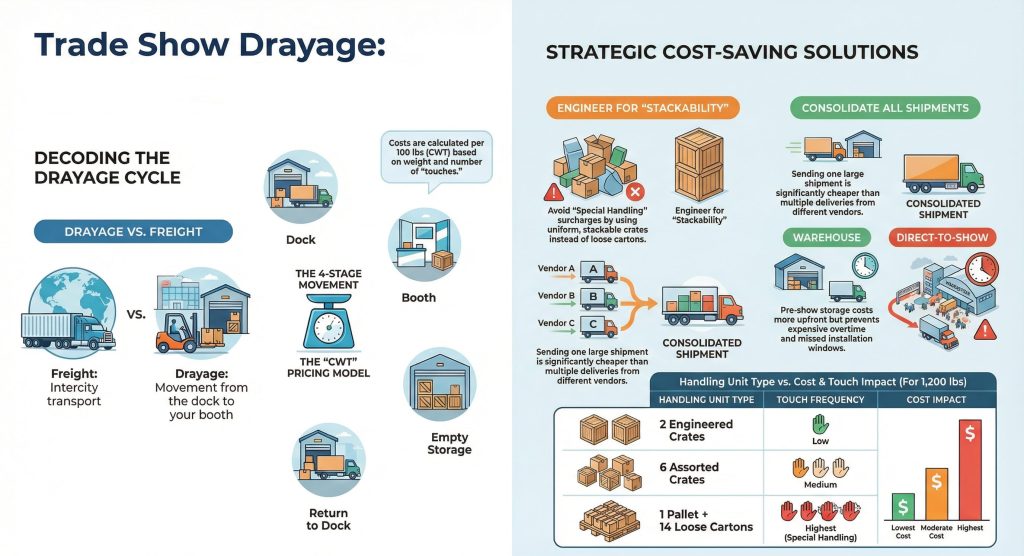
If you’re going to a trade show in the US, here’s the deal : The moving company can get your booth to the front of the convention center… but the booth hasn’t “arrived” yet. Not in the sense you might think. Not in the sense of “we can start setting it up.” Trade show booth moving and Drayage is what happens after the truck arrives: the controlled movement of the cargo from the dock to the booth space, the storage and movement of empty boxes/crates during the show, and the return of those same crates when it’s time to pack up.
Dock → booth → warehouse/storage → booth → dock.
Many people hear “Drayage” and think it means trucking. No. Long-distance shipping becomes “freight,” or “freight.” The Drayage is the reality of the forklift and the labor inside the building, under the show's and the hall's rules. And yes, you usually pay for both entry and exit. It’s the exit fee that surprises newbies.
Trade Show Drayage Explained: What Exhibitors Must Know
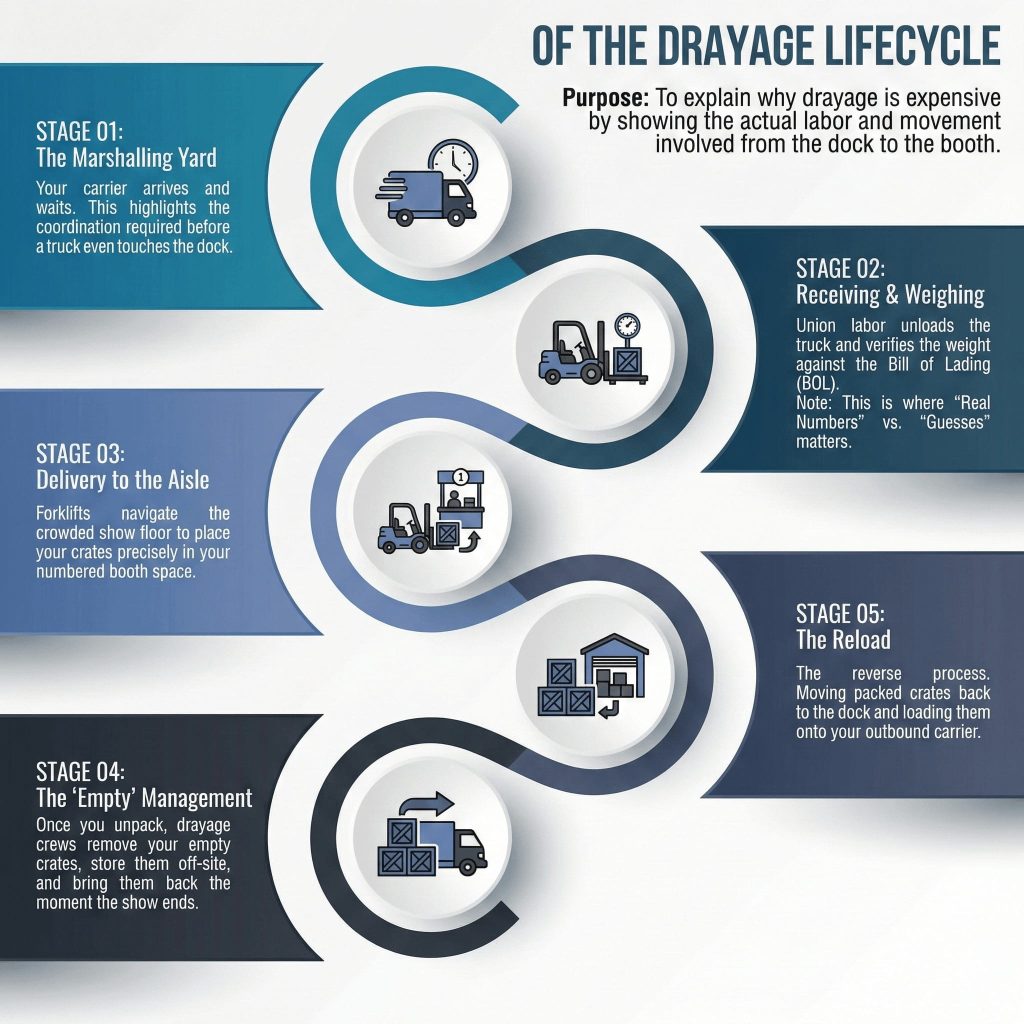
Almost every major show in America has an official service contractor. The docks, human resources, equipment, schedule, and responsibilities are in their hands. That’s why you can’t just show up with your own forklift, your own team, and an iron will and say, “We’ll do it ourselves.” They’ll stop you. Sometimes respectfully. Sometimes not so much. The contractor isn’t doing it because he woke up in the morning and decided to get on your nerves. It does this because the venue and the organizer want someone to be in charge of what goes where and when. This includes safety, labor/union rules, dock congestion, insurance, and the fact that the convention center is moving like a giant jigsaw puzzle during arrival and setup. To be honest, I’ve worked at a lot of venues across the US. Some of the rules make sense; some feel like they were written by someone who hates exhibitors. But the pattern is the same: the dock and the equipment are controlled, and Drayage is part of the contract.
Wait… “part of the contract” is too soft. The Drayage is the contract itself.
Trade Show Booth Shipping & Drayage vs freight vs I&D:
This is where budgets fall apart : Freight means intercity: LTL, dedicated truck, air, you name it.
Booth hauling and Drayage is the contractor who moves the goods into the building.
Installation and Disassembly (I&D) is the labor to assemble and dismantle the booth. This can be your own team (less often allowed at larger shows), or a contractor’s team, or the booth construction company’s team, depending on the show rules and the contract you signed. Three categories. Three separate factors. One event. If you mix these up, you’re doing exactly what many people do: comparing booth prices without considering shipping strategy, number of crates, installation complexity, and venue rules. Then you wonder why the “cheaper” booth ended up costing more. I’ve seen companies fall in love with a great build, then get suffocated by the total cost because no one talked about shipping. The problem wasn’t the design. The planning problem was a numerical one.
Trade Show Booth Shipping & Drayage pricing
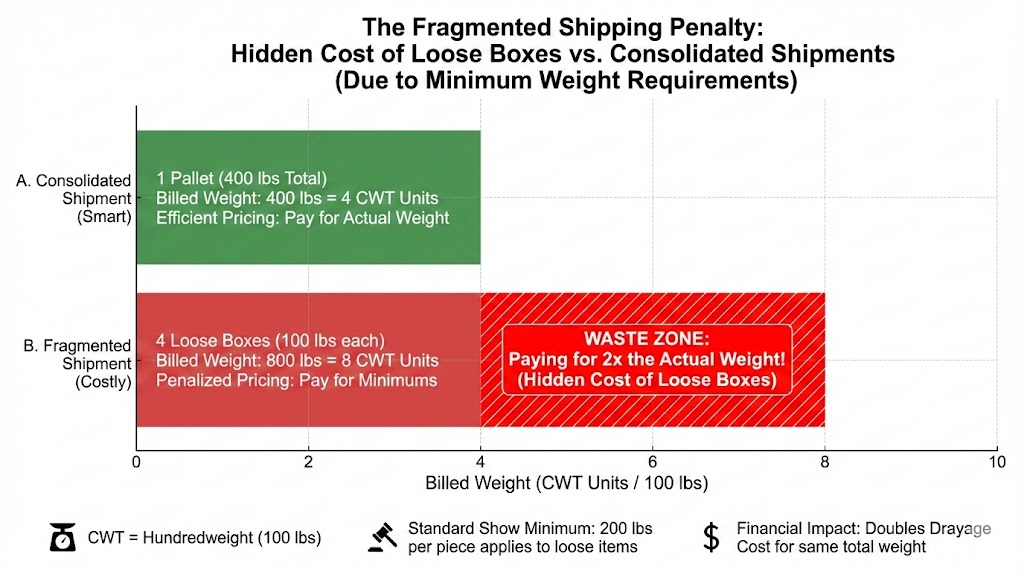
Most contractors calculate Drayage in CWT (cost per 100 pounds), usually with specific minimums and classifications.
So you’ll usually end up with:
- Rate per 100 pounds
- Minimum amount per shipment
- Special rate for “special handling” (above)
- Over time, if scheduling is bad
- Departure fee at time of collection
I’m not going to pretend there’s a single rate in 2026. There isn’t. Rates vary by show, venue, city, union status, and event crowd. But the pricing logic is often the same.A clean, stackable crate on a pallet doesn’t get the same treatment as a bunch of sloppy cardboard and odd bits and pieces. And when the contractor has to handle your shipment more, the cost goes up. Not because they hate you, but because human resources is human resources and forklifts don’t do miracles. I used to think “lighter = cheaper.” Then I saw that a lightweight booth shipped in 12 pieces cost more to move than a heavier booth in two crates. That’s when it hit home.
if you need better and detail Trade show booth costs estimate click on the link .
Trade Show Booth Drayage & Handling Unit Problem
A “handling unit” is a moveable piece: a crate, a pallet, a skid, and sometimes even a large carton, depending on how it’s packaged and labeled.
You could ship 1,200 pounds like this:
- 2 engineered crates (2 handling units)
- 6 assorted crates (6 handling units)
- 1 pallet + 14 loose cartons (good luck)
The weight is the same. The number of touches is different. The staging requirement is different. The time at the dock is different. The cost is different. This is important if you really want to predict the cost of the entire show accurately. Because if your booth design creates a whole bunch of separate pieces — separate counters, separate shelves, separate monitors in separate boxes, accessories in scattered cartons — you’ve quietly turned your booth into a full-touch shipment. And trade show shipping and logistics love full-touch shipments, just as parking meters love your ignorance. A very common pattern: The company goes from a simple 10x10 to a “slightly more customized” 10x20, but doesn’t change the packaging method. More pieces, more cases, more cartons. It thinks the booth is bigger, so the costs go up “a little.”
That’s why in Methodex company we design the crates at the same time as the booth design, not after.
Warehouse VS Direct-To-Show in Shipping Timing
You usually have two options:
1) Ship to pre-show storage (a few weeks in advance)
2) Ship directly to the show floor (closer to arrival time)
Pre-show storage is more expensive on paper. You’re paying for a contractor to pick up and hold your shipment earlier. But it reduces the risk. When the arrival time starts, your shipment is in the system. Direct shipping can work, especially for smaller booths. But it’s more fragile. One traffic delay, one missed turn, a line at the marshalling yard… and now the installation team is staring at a space, and the clock is ticking. in 2026, that “clock” isn’t cheap. Labor and overtime costs aren’t going down in big cities. So delays aren’t just stress; they’re numbers. But here’s what I didn’t expect: Some clients ended up paying less overall when they chose pre-show storage. Not because storage is cheap, but because there’s less overtime and fewer last-minute “fix it now” costs. This isn’t always the case. It depends on the show, the hall, and the complexity of the booth. But if you have a custom booth and your setup is tight, pre-show storage is often the smoother route.
Trade Show Booth Shipping & Drayage “special handling method.”
If you want rates to go up, enable special handling. Common triggers for booth shipping:
- Floor loading (no pallets)
- Mixed or unstable loads
- Non-stackable crates
- Large pieces that require additional equipment or force
- Carpet rolls and graphic tubes
- Odd shapes and half-pallets
When this tag is used, both shipping and handling rates go up. Much of this can be prevented with better packaging.
This is where booth engineering pays off.
The mistakes we keep seeing (and yes, they’re fixable)
I’m being a bit pessimistic here, because I am.
Separate shipments from multiple vendors
One place for construction, one place for graphics, one place for flooring, one place for gifts. Each delivery has a separate receipt, stage, and move. You are doubling the risk and cost of shipping the booth and the freight.
Shipping booth parts by mail/parcel
FedEx and UPS are great for samples and brochures. For booth parts, they usually cause more hassle, hidden costs, and confusion at the time of receipt.
Guessing weight on forms
Some people guess. Then the contractor takes the actual weight and bills the difference. The surprise is not the contractor’s fault; it was your guess.
Loose and oddly shaped carton
If it is not shipped clean, it will be treated differently. And if it is treated differently, it will be billed differently.
Non-collapsible crates “for security.”
Sometimes necessary. But more often than not, it means the crate design was lazy. A sturdy crate can be both protective and collapsible. We make both.
How to reduce Booth Shipping & Drayage problems
Here’s where our job goes from “make pretty” to “make it work.”
Crate Engineering for trade show booth
Not as a last resort. Not with a ready-made road case found in the warehouse. A custom crate that fits exactly with the booth pieces, protects, and moves cleanly.
Minimizing Unique Parts
Integrated features are better than separate boxes. If your lighting system has three separate cartons and a separate bag of screws, it’s chaos on site. We simplify.
Nesting and Modularity
Frames that fit inside each other. Compact panels. Countertops that come in one piece. Hardware that lives in a specific, labeled kit. Not a pretty sight until you see the invoice.
Weight Distribution in drayage
Even weight on the skid. Stable load. Stackability as much as possible. These reduce the risk of specific handling.
Design for the venue not booth shipping
Some venues have tighter docks, schedules, and check-in windows. We design for that reality. To be honest, I got this wrong at first. I thought a booth was a booth and shipping was shipping. Then we
A pre-ship checklist for trade show Drayage that saves money
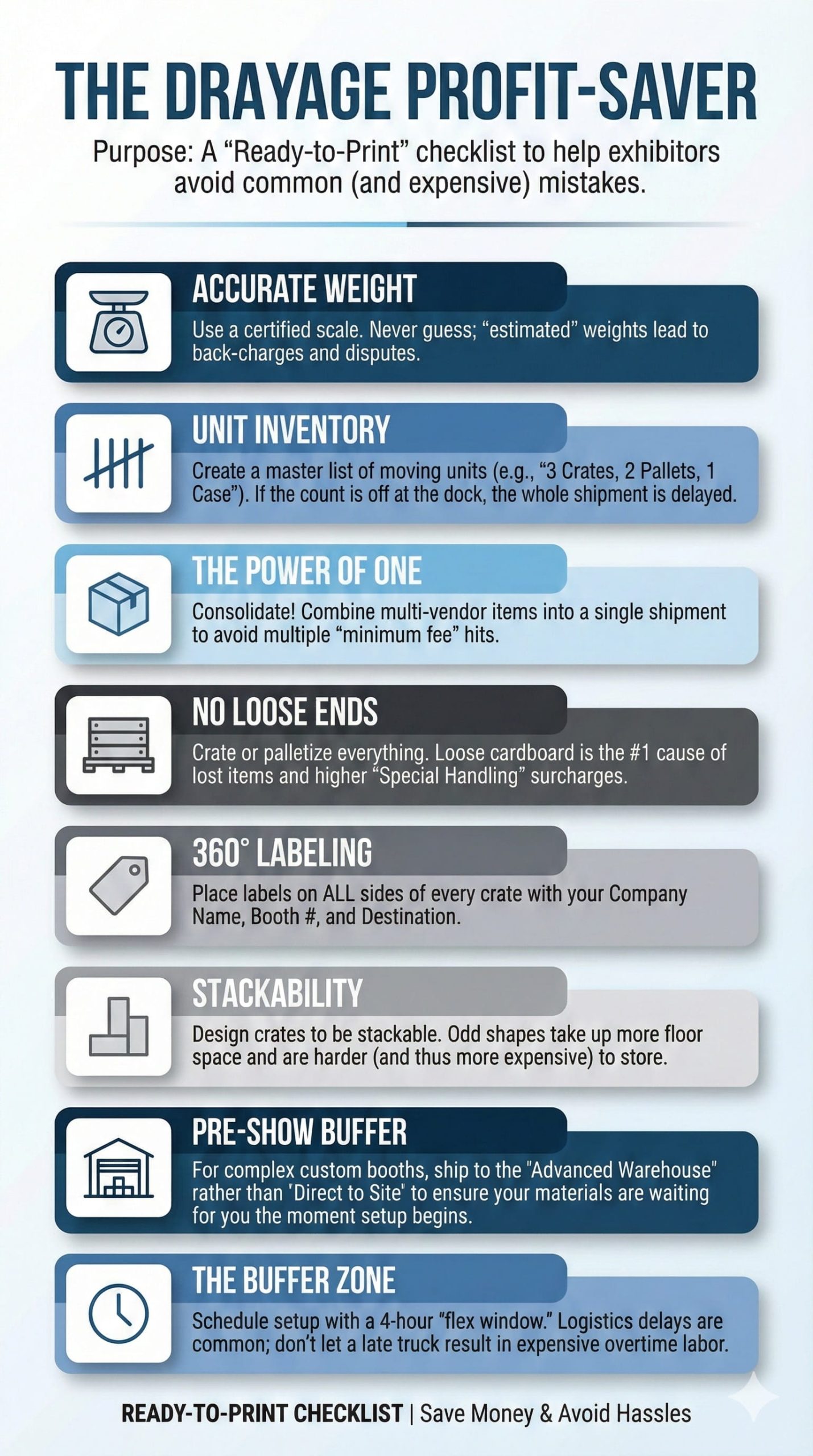
I wish more clients would take this seriously:
- State the total weight in real numbers, not guesses.
- Count the number of moving units: crates, pallets, skids, cases.
- Consolidate shipments as much as possible; multi-vendor shipments are a pain.
- Crate or palletize everything; minimize loose cardboard.
- Clearly label all sides of crates: booth number, company, destination.
- Make as many stackable crates as possible; eliminate odd shapes.
- For custom booths with tight setups, consider pre-show storage.
- Set a realistic schedule for setup; delays are possible.
It never guarantees that nothing will happen. A show is a show. But it does reduce common points of failure. read more about exhibitor checklist in trade shows.
One Question That Changes How You Buy a Booth
Before you commit to a booth design — before you fall in love with a render — ask this:
How many crates will this booth ship in, and what does that mean for booth shipping and Drayage?
If someone can't answer, you have a warning sign right there. Because the factor will answer later. Loud. you can also read more about buying or renting a booth in exhibition.